Tuesday, March 24, 2009


Friday, March 20, 2009
How Obama can repair AIG damage
I am not sure that anyone really knows what is going on in the economy...but I am sure that there are some profiteers and robber barons who know exactly how to take advantage of the situation. I believe in free markets(at least I think I do)...but they must also be fair and accountable markets. Actions taken by our government, regulators, and business insiders over the past dozen years have eliminated much of the fairness and accountability of the market, which may result in much of the freedom being stripped away. Let us all remain vigilant, be willing to speak truth to power, and never allow our current view to block our vision as we navigate these uncertain waters.

By Drew Westen
Special to CNN
Editor's Note: Drew Westen is professor of psychology and psychiatry at Emory University, founder of Westen Strategies and author of "The Political Brain: The Role of Emotion in Deciding the Fate of the Nation." He has been a consultant or adviser to several candidates, nonprofit organizations and Fortune 500 companies, and informally advised Barack Obama's campaign.
ATLANTA, Georgia (CNN) -- In getting the nation's economy back on its feet and pursuing an agenda aimed at keeping it there for the next 40 years, the White House has to do two things at once: implement effective policies and keep the public behind the president long enough to keep implementing them until they work.
As the president learned in the stimulus debate, even the best policies don't sell themselves, especially when the other side is aggressively attacking them. President Obama's inspiration, Abraham Lincoln, noted that without public opinion behind you, good governance is impossible.
In this sense, the AIG debacle, in which the government has handed nearly $200 billion of taxpayers' money to one of the corporate Leviathans whose misadventures have cost many taxpayers their jobs, homes and savings, is both instructive and destructive.
The White House needs to be able to go back to the American people if the banks need another infusion of capital or the economy needs another stimulus -- both of which are high-probability events -- and the president needs public opinion at his back to enact his ambitious agenda on infrastructure, health care and education.
So aside from offering the kind of sweeping and long-needed regulatory reforms he proposed Wednesday (the policy side of the equation), what does President Obama need to do to prevent the AIG fiasco from eroding public confidence in what government can do in times like these?
Three things. First, he needs to make sure, when a story like this one breaks, that he and his public surrogates are all on the same page. The president got it right with his cool public outrage and his order to his Treasury Secretary to look harder for ways to stop another round of public theft.
In the same way, his press secretary, Robert Gibbs, responded with just the right tone to Dick Cheney's attempt to pin both the Bush economy and the next terrorist attack on the new administration. Gibbs wryly noted that Rush Limbaugh was apparently unavailable to do the interview and that the former vice president was not in much demand right now for his economic advice.
But watching some of the president's chief economic advisers publicly throw up their hands in helplessness, suggesting the government could feed the monster but couldn't control it, was a reminder of what happens when presidential surrogates speak without proper media training, a unified message and a clear sense of why getting their message right on this really matters.
Second, the White House needs to speak in plain language to the American people about what needs to be done, so it harnesses their legitimate anger and anxiety and continues to inspire their confidence and hope.
Americans understand that if you own 80 percent of a company (like the federal government owns of AIG), you are in the position to tell senior management what to do, and if you can't, you need a new lawyer, because you wrote a bad contract.
Americans could readily understand that if a single company is so important that its demise would spell the demise of the entire economy, then it should either be owned, tightly regulated (as public utilities are), or split up by the government, because we can't afford to have our common interest held hostage to the private interests of any single company.
Americans also would not have a visceral reaction to temporary "nationalization" of failing banks if someone would stop calling it nationalization and tell a coherent story about what happened and why we have to take the steps we do: that the Bush administration, in its bank bailout, socialized the risks of sleazy business practices while privatizing the gains, and that isn't fair.
If we as taxpayers are going to assume the risk as stakeholders when bankers make bad decisions, we should reap the profits as shareholders when those banks are profitable again, and use that money to pay down the national debt, cut our taxes and get a solid return on our investment.
That leads to the third point. The president needs to tell the American people the story, over and over, of how we got in this mess, who put us in it and what will and won't get us out of it. Franklin Roosevelt had no trouble pinning the nation's economic difficulties on the Republicans who had fiddled with free-market extremism as the nation's economy burned, and it took 40 years and the charisma of Ronald Reagan for anyone to put voice to that ideology again.
A good story typically has protagonists, antagonists, a battle between them and a resolution. The president has a penchant for telling stories without antagonists (even while those antagonists are antagonizing him, with their rhetoric of "borrow and spend," "socialism," etc.).
When referring to the causes of our economic meltdown, he often reverts to passive voice (something "was done") or to nameless, faceless, impersonal forces ("corporate greed"). The reality is that we're in this mess because for eight years we were in the grip of a radical economic ideology that preached that all would be well if we just gave free rein to corporate greed and removed all constraints on it.
The unspoken (and sometimes spoken) idea was that if we just let the people who know the most about energy (energy executives, of course) shape our energy policy in private meetings, the people who know the most about meat production (the cattle and meat-packing industries) regulate meat production, and the people who know the most about Wall Street (bankers, hedge fund managers, and derivatives traders) regulate (or refuse to regulate) banking and investing, everything would be fine.
The fact that the federal government engineered a $170 billion no-strings-attached, no transparency required bailout to AIG when the economy was melting down was not a deviation from that philosophy. It was its logical extension.
The president needs to make clear where his policies -- and values -- depart from those of the previous administration if he wants people to hang onto their tenuous, newfound belief that maybe this time government is part of the solution and not the problem.
The opinions expressed in this commentary are solely those of Drew Westen.
Find this article at:
http://www.cnn.com/2009/POLITICS/03/19/westen.obama.aig/index.html
Copyright 2008 Cable News Network
Tuesday, March 10, 2009
War Message Found Inside Lincoln's Watch
I think I am starting to believe that movies like National Treasure might have some truth in them?! This is really too cool!

By Kelly Marshall
(CNN) -- A long-hidden message has been discovered inside Abraham Lincoln's pocket watch, the Smithsonian's Museum of American History announced Tuesday.
Watchmaker Jonathan Dillon was repairing Lincoln's watch in April 1861 when he heard about the attack on Fort Sumter, South Carolina, and wrote a short message on the metal inside the watch, the Smithsonian said.
There it remained, unseen for almost 150 years, it said.
In a 1906 interview with The New York Times, Dillon reported that as soon as he heard the news about the first shots of the Civil War, he unscrewed the dial of the watch and wrote on the metal, "The first gun is fired. Slavery is dead. Thank God we have a President who at least will try."
The actual message that the museum found differs from the watchmaker's recollection. It says, "Jonathan Dillon, April 13-1861, Fort Sumpter [sic] was attacked by the rebels on the above date J Dillon, April 13-1861, Washington, thank God we have a government, Jonth Dillon."
According to the Smithsonian, it was not unusual for professional watchmakers to record their work inside a watch.
"Lincoln never knew of the message he carried in his pocket," said Brent D. Glass, director of the National Museum of American History.
The museum decided to open the watch after being contacted by the watchmaker's great-great-grandson, Doug Stiles, who had heard about the message Dillon said he had inscribed and wanted to see if it was really there.
Find this article at:
http://www.cnn.com/2009/US/03/10/lincoln.watch/index.html
Copyright 2008 Cable News Network
Powered by ScribeFire.
Thursday, March 05, 2009
Sojourners: Our Moral Audit of the Budget
While there may be some specifics to disagree with, I concur with the overall assessment of the change in our national budget priorities. I hope the evangelical center and left will continue to speak truth to power and lay aside quibbles for the time being...I hope. I hope the evangelical right can find a way to acknowledge honest policy differences with their brothers and sisters in Christ yet remain in loving fellowship bound by a common love for a risen Lord and a willingness to walk in his Way...I hope.

by Jim Wallis 03-02-2009
Four years ago, faced with a disastrous federal budget proposal, Sojourners coined a phase, “budgets are moral documents.” That phrase has now entered the common lexicon, but it remains our fundamental principle. Budgets reflect the values and priorities of a family, church, organization, city, state, or nation. They tell us what is most important and valued to those making the budget. So, it is important that we do a “values audit” of President Obama’s proposed budget, a “moral audit” of our priorities. Who benefits in this budget, what things are revealed as most important, and what things are less important? America’s religious communities are required to ask of any budget: what happens to the poor and most vulnerable — especially, what becomes of the nation’s poorest children in these critical decisions?
The values of the American people should also be applied to the budget, e.g. fairness (everyone paying their fair share); opportunity for all Americans; fiscal, personal, and social responsibility; balancing important and different priorities; defining security more broadly than just military considerations, as it is related to economic and family security too; compassion and protection for the vulnerable; building community; and upholding the common good.
That’s a principle that has been forgotten in the past years. We have trusted in “the invisible hand” of the market to make everything turn out all right, but things too often haven’t turned out all right. The invisible hand let go of some things, like the common good. The idea that policies which benefit the wealthiest will eventually benefit everyone has proven false. The president’s budget is a step toward restoring the value of the common good to our policy. It is a step to rebalance our priorities, protect the vulnerable, and strengthen the middle.
It contains major investments in the president’s three priorities: significantly expanding health care coverage, focusing on climate change reduction and developing renewable energy, and investing in education – early childhood programs, strengthening and reforming public schools, expanded opportunities for college — all of which will benefit low-income people. There are also specific changes in important areas such as tax policy, food and nutrition programs, housing, needed aid to veterans, prisoner re-entry, global food security, and increased foreign aid for combating pandemic disease. It’s a budget aimed at redressing the imbalances.
The growing inequality in America over decades is a sin of biblical proportions, and it’s time to bring our principles of social justice to bear. As columnist E.J. Dionne wrote,
The central issue in American politics now is whether the country should reverse a three-decade-long trend of rising inequality in incomes and wealth. Politicians will say lots of things in the coming weeks, but they should be pushed relentlessly to address the bottom-line question: Do they believe that a fairer distribution of capitalism’s bounty is essential to repairing a sick economy? Everything else is a subsidiary issue.
It is that question that should guide our moral audit of the budget. The fundamental moral question in the upcoming budget debate is whether to begin to reverse the rapid and massive increase in American inequality which has grown over the past thirty years — and has dramatically increased during the past eight. I believe it is time to stop helping the undeserving rich, under the now demonstrably false assertion that this will then benefit the rest of us. When the top 1 percent of the country now get 20 percent of its income, control 33 percent of its wealth, and pay a smaller percentage of their income in taxes than their receptionists do (as Warren Buffet has pointed out)—something has gone terribly wrong in America. The new Obama budget is the first and dramatic step to fix all that, and turn the nation in a different direction.
The new budget proposed by the White House is a dramatic step in the direction of the common good, with strong support for the middle of America, real help for the poorest among us, and the proposition that the wealthiest pay their fare share. And my prediction is that many in the faith community, especially those on the front lines of serving the poor, will rally around the principles and priorities of this budget, bringing their energy and advocacy to bear on the debate that now lies ahead. Because this will not just be a policy debate, but also a moral one; the prayers of the faithful — along with their watchful eyes, willing hands, and ready feet — will surround the congressional budget process over the next few months.
This post comes from Jim’s remarks at a media teleconference on March 2, 2009. Click here to listen to the call.
Sojourners | 3333 14th Street NW, Suite 200 | Washington, DC 20010
Phone 202.328.8842 | Fax 202.328.8757 | sojourners@sojo.net
Unless otherwise noted, all material © Sojourners 2008
Powered by ScribeFire.
Sunday, March 01, 2009
Secretary of Defense: Obama Is More Analytical Than Bush
Sometimes the first duty of intelligent men is the restatement of the obvious. -- George Orwell

WASHINGTON - Tell us, Robert Gates, what's the difference between working under Barack Obama and working under George W. Bush as defense secretary?
"That sounds like the subject of a good book," Gates said with a smile.
"It's really hard to say," he continued during an interview aired Sunday on "Meet the Press" on NBC.
"I think that probably President Obama is somewhat more analytical. And he makes sure he hears from everybody in the room on an issue. And if they don't speak up, he calls on them."
And the former president?
"President Bush was interested in hearing different points of view but didn't go out of his way to make sure everybody spoke if they hadn't spoken up before," Gates said.
Bush picked Gates to succeed Donald H. Rumsfeld as defense secretary in November 2006. The following June, Gates recommended that Bush appoint Adm. Mike Mullen as the next chairman of the Joint Chiefs of Staff, the nation's top military officer.
When Mullen was asked Sunday to compare the styles of the two presidents, he demurred.
"Well, I think individuals are always different," Mullen said on "State of the Union" on CNN. "But, you know, I mean, I wouldn't characterize them one way or the other."
That said, Mullen remarked that Obama listens to his military advisers.
"He's anxious to get the military's input to all his decisions," Mullen said. "The discussions have been broad and deep, and I've been very comfortable both with the access and the ability to give that advice."
Both Gates and Mullen remained in their positions in the opening weeks of the Obama administration. Gates told NBC that it would be "a challenge" to serve as defense secretary for the entirety of Obama's term.
The Associated Press
updated 2:27 p.m. CT, Sun., March. 1, 2009
Copyright 2009 The Associated Press. All rights reserved.
URL: http://www.msnbc.msn.com/id/29453760/
© 2009 MSNBC.com
Powered by ScribeFire.
Thursday, February 26, 2009
Why the New York Post Cartoon Is Hurtful...
Do you find the cartoon below offensive or otherwise hurtful? If not, I suggest a personal exploration of the history of our nation and a time of intentional listening to those whose relatives and ancestors were not only offended; but, deprived of life, liberty, and the pursuit of happiness.

Posted on Wed, Feb. 25, 2009
By LEONARD PITTS JR.

'Police and deputy sheriffs hunted Wednesday night for a negro `beast man' . . . ''
-- The Billings Gazette,
Sept. 19, 1929
An original Guinea negro whose blood has not been crossed is as docile as a shepherd dog . . . ''
-- The Atlanta Constitution,
June 4, 1899
"Miss Mary Henderson The Victim of a Negro Beast''
-- The Moberly Weekly Monitor,
Aug. 29, 1901
"For two minutes [Joe Louis] was a throwback to a wild jungle creature . . . ''
-- The Associated Press,
Jan. 14, 1940
"Towering above them all, his black apelike face, distorted with rage . . . ''
-- The Oelwein Daily Register,
April 24, 1919
"Northerners cannot realize how low in intelligence, how irresponsible the pure negro is. He is an animal . . . ''
-- The New York Times,
June 9, 1901
Just so we're all clear on why black folk tend to get annoyed when newspapers compare them to animals.
For all that, though, it was not the New York Post's now-notorious chimp cartoon that offended me. Rather, it was everything that came after.
Last week's cartoon, referencing a recent incident in which police killed a chimpanzee that mauled a woman in Stamford, Conn., depicts two officers standing over the bullet-riddled body of a dead ape. One says to the other: ``They'll have to find someone else to write the next stimulus bill.''
Some observers were outraged, believing that cartoonist Sean Delonas had likened President Barack Obama to a chimp. I thought it equally likely he meant to taunt congressional Democrats (the president, after all, did not ''write'' the stimulus bill) and had inadvertently blundered into an awful racial stereotype. Given that ambiguity, my instinct was to give Delonas the benefit of the doubt.
Then he opened his mouth.
He and his bosses, actually. First, there was the strident defense: 'absolutely friggin' ridiculous'' said the cartoonist in a statement to CNN. Later, with protesters ringing its building and finding itself questioned and criticized by everyone from the National Association of Black Journalists to New York Gov. David Paterson to the NAACP, the paper issued a grudging, churlish apology in which, even while expressing regret, it tried to blame the controversy on ''opportunists'' to whom ``no apology is due.''
It took nearly a week before it dawned on the paper's braintrust that maybe people had good reason for their vexation. Tuesday, media baron Rupert Murdoch, who owns the Post, issued a new apology, no strings attached.
That it took so long to do the obvious speaks volumes.
Let's be clear on one thing: The Post has a right to provoke and even offend. That is absolute and sacrosanct. But it is difficult not to be troubled by a suffocating cluelessness that allows it to provoke and offend without knowing it or meaning it or even, apparently, caring about it -- and then, to dismiss provocation and offense as the work of ''opportunists'' instead of seeking to understand why people were so upset.
The paper's attitude, its evident ignorance of historical context, are not unique. Rather, they have their echo in too many white Americans whose default defense is the proverbial good offense whenever they feel cornered on the subject of race.
And yes, that attitude is fed by the fact that in recent years too many African Americans have found it convenient to cry wolf where race is concerned. But if arrogance on the one end and disingenuousness on the other are our only alternatives, we're in trouble.
Fittingly, this all unfolds in the wake of Attorney General Eric Holder's contention that we need to become better and braver in talking about race. Take the Post's self-satisfied ignorance as Exhibit A.
The paper didn't know that it didn't know. One hopes the next time controversy comes calling it will, before deploying its defenses, do what it should have done here.
Shut up and listen.
© 2009 Miami Herald Media Company. All Rights Reserved.
http://www.miamiherald.com

Posted on Wed, Feb. 25, 2009
By LEONARD PITTS JR.
'Police and deputy sheriffs hunted Wednesday night for a negro `beast man' . . . ''
-- The Billings Gazette,
Sept. 19, 1929
An original Guinea negro whose blood has not been crossed is as docile as a shepherd dog . . . ''
-- The Atlanta Constitution,
June 4, 1899
"Miss Mary Henderson The Victim of a Negro Beast''
-- The Moberly Weekly Monitor,
Aug. 29, 1901
"For two minutes [Joe Louis] was a throwback to a wild jungle creature . . . ''
-- The Associated Press,
Jan. 14, 1940
"Towering above them all, his black apelike face, distorted with rage . . . ''
-- The Oelwein Daily Register,
April 24, 1919
"Northerners cannot realize how low in intelligence, how irresponsible the pure negro is. He is an animal . . . ''
-- The New York Times,
June 9, 1901
Just so we're all clear on why black folk tend to get annoyed when newspapers compare them to animals.
For all that, though, it was not the New York Post's now-notorious chimp cartoon that offended me. Rather, it was everything that came after.
Last week's cartoon, referencing a recent incident in which police killed a chimpanzee that mauled a woman in Stamford, Conn., depicts two officers standing over the bullet-riddled body of a dead ape. One says to the other: ``They'll have to find someone else to write the next stimulus bill.''
Some observers were outraged, believing that cartoonist Sean Delonas had likened President Barack Obama to a chimp. I thought it equally likely he meant to taunt congressional Democrats (the president, after all, did not ''write'' the stimulus bill) and had inadvertently blundered into an awful racial stereotype. Given that ambiguity, my instinct was to give Delonas the benefit of the doubt.
Then he opened his mouth.
He and his bosses, actually. First, there was the strident defense: 'absolutely friggin' ridiculous'' said the cartoonist in a statement to CNN. Later, with protesters ringing its building and finding itself questioned and criticized by everyone from the National Association of Black Journalists to New York Gov. David Paterson to the NAACP, the paper issued a grudging, churlish apology in which, even while expressing regret, it tried to blame the controversy on ''opportunists'' to whom ``no apology is due.''
It took nearly a week before it dawned on the paper's braintrust that maybe people had good reason for their vexation. Tuesday, media baron Rupert Murdoch, who owns the Post, issued a new apology, no strings attached.
That it took so long to do the obvious speaks volumes.
Let's be clear on one thing: The Post has a right to provoke and even offend. That is absolute and sacrosanct. But it is difficult not to be troubled by a suffocating cluelessness that allows it to provoke and offend without knowing it or meaning it or even, apparently, caring about it -- and then, to dismiss provocation and offense as the work of ''opportunists'' instead of seeking to understand why people were so upset.
The paper's attitude, its evident ignorance of historical context, are not unique. Rather, they have their echo in too many white Americans whose default defense is the proverbial good offense whenever they feel cornered on the subject of race.
And yes, that attitude is fed by the fact that in recent years too many African Americans have found it convenient to cry wolf where race is concerned. But if arrogance on the one end and disingenuousness on the other are our only alternatives, we're in trouble.
Fittingly, this all unfolds in the wake of Attorney General Eric Holder's contention that we need to become better and braver in talking about race. Take the Post's self-satisfied ignorance as Exhibit A.
The paper didn't know that it didn't know. One hopes the next time controversy comes calling it will, before deploying its defenses, do what it should have done here.
Shut up and listen.
© 2009 Miami Herald Media Company. All Rights Reserved.
http://www.miamiherald.com
Powered by ScribeFire.
Tuesday, February 24, 2009
John McCain: Cost Overruns Have Military Facing 'Train Wreck'
Finally, I am starting to see the real McCain reemerge! Go get'em McNasty!
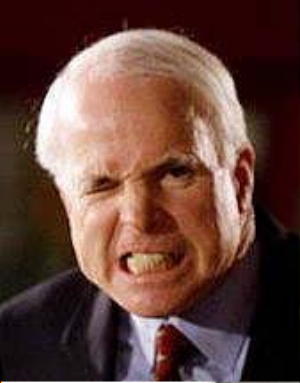
WASHINGTON (CNN) -- Cost overruns on big-ticket Pentagon projects have left the U.S. military facing a budgetary "train wreck" at a time of growing budget deficits, Sen. John McCain said Tuesday.
McCain and Sen. Carl Levin, D-Michigan and the chairman of the Senate Armed Services Committee, said the cost of 95 major weapons systems -- ships, aircraft and armored vehicles -- have ballooned by a total of 30 percent in recent years, to about $1.3 trillion.The senators announced an effort, including legislation, to rein in that spending and tighten Defense Department oversight.
With U.S. troops fighting two wars overseas and personnel costs dominating the defense budget, "We're facing a train wreck," said McCain, the ranking Republican on the committee and the GOP's presidential candidate in 2008.
"We cannot continue on this path of escalating costs without at some point making some tough choices, which may endanger our nation's security," he said.
McCain and Levin singled out the Navy's planned construction of Littoral combat ships, a class of small vessels designed for coastal operations, for particular criticism. Levin said the ships are "way beyond" their projected construction time of two years, and the program has grown from a cost per ship of about $220 million to more than $500 million, according to a November report from the Congressional Research Service.
"We can't have a ship that's a small ship that's supposed to be built in two years run completely out of control to double or triple or quadruple its original cost estimates," McCain said.
He also criticized the planned purchase of 28 new Marine helicopters for the White House that he said cost "more than Air Force One." But White House spokesman Robert Gibbs said Tuesday that President Barack Obama has put that $11 billion order on hold.
Pentagon spokesman Bryan Whitman said Tuesday that the Defense Department is committed to reviewing its big-ticket contracts, "particularly those programs that are underperforming." The presidential helicopter project "is one of those programs," he said.
Levin and McCain said their push will include hearings into military contracting, legislation creating new watchdog posts in the Pentagon and an effort to stiffen congressional oversight of big-ticket programs.
"The Department of Defense has the major responsibility to make sure that these programs are run efficiently. Congress has an oversight responsibility," Levin said. "Neither of those activities have been carried out adequately."
Their announcement comes as Obama is scheduled to deliver his budget address to Congress, and Defense Secretary Robert Gates is already examining whether to cut back on some of the armed services' biggest purchases.
"This moment also presents an opportunity, one of those rare chances to match virtue to necessity, to critically and ruthlessly separate appetites from real requirements," Gates told a Senate hearing in January.
Among the other items under scrutiny: The $950 billion joint strike fighter program, the Army's $200 billion Future Combat System and the Navy's Virginia-class attack submarines.
"We are going to have lots of fights in the next two or three months over various parts of the defense budget," said Winslow Wheeler, an analyst for the nonprofit Center for Defense Information.
The plans have leading defense contractors and members of Congress with contractors' factories in their districts already arguing to keep their programs intact. Lockheed Martin's F-22 program, for instance, employs about 12,000 people in 44 states, its supporters argue.
But Wheeler said defense spending produces "significantly less" employment than spending in other areas, such as mass transit or health care.
CNN's Barbara Starr and Mike Mount contributed to this report.
Find this article at:
http://www.cnn.com/2009/POLITICS/02/24/congress.pentagon/index.html
Copyright 2008 Cable News Network
Powered by ScribeFire.
Tuesday, February 17, 2009
Hey, Obama, It Is Time to Step Up Your Game!
CNN's Jack Cafferty considers the stimulus bill a sorry spectacle; and I think he is pulling some punches. Each party only seems to care about their portion of the American electorate. Republicans are only governing for Republicans and Democrats are only governing for Democrats. Hey guys and gals, whether you like it or not, Republicans have to govern for liberals and Democrats have to govern for conservaties! Suck it up, pull on your big boy and big girl underwear, and do the following: "form a more perfect union, establish justice, insure domestic tranquility, provide for the common defense, promote the general welfare, and secure the blessings of liberty to ourselves and our posterity." That is your only job...and you currently suck at it!

By Jack Cafferty
CNN
NEW YORK (CNN) -- What a joke. Your Congress has voted to spend almost $790 billion of your money on a stimulus package that not a single member of either chamber has read.
The 1,073-page document wasn't posted on the government's Web site until after 10 p.m. the day before the vote to pass it was taken. I don't care if you're Evelyn Wood, you can't read almost 1,100 pages of the lawyer talk that makes up all legislation in eight or 10 hours.
The criminal part of this boondoggle is divided into two parts. The first is the Democrats promised to post the bill a full 48 hours before the vote was taken to allow members of the public to see what they were getting for their money. Both parties voted unanimously to do this ... and they lied.
It didn't happen. Why am I not surprised? Congress lying to the American people has become part of their job description. They can't be trusted on anything anymore.
I'm sure part of the reason there was no time for the public to read the bill was the 11th-hour internecine warfare between House Speaker Nancy Pelosi and Senate Majority Leader Harry Reid.
When Reid first announced the compromise had been reached, Nancy Pelosi was nowhere to be seen. And it would take an act of God for this egotistical, arrogant woman to miss a photo op where she could take credit for anything. But she wasn't there.
She summoned Reid to her office, where unnamed sources said she blew her top over some provision for schools that she wasn't happy with. Pelosi's snit delayed everything.
It's really too bad President Obama couldn't figure out a way to jettison these two who are poster children for everything that is wrong in Washington. The Associated Press called the birth of the stimulus bill "sausage making" in the best tradition of Washington politics as usual.
The second part of the crime is the contents of the bill itself. Far from being only about jobs, infrastructure and tax cuts as promised, the stimulus bill stimulates a bunch of other stuff as well. Eight billion dollars for high-speed rail lines, including a proposed line between Las Vegas and Los Angeles. This little bit of second story work wasn't even in the House version of the bill.
It started in the Senate as a $2 billion project, and came out of the conference committee costing a whopping $8 billion. Gee, now who would that benefit? Oh yeah, the Senate majority leader is from Nevada.
Filipino veterans, most of whom don't live in the U.S., will get $200 million in compensation for World War II injuries. And: $2 billion in grants and loans for battery companies, $100 million for small shipyards and a rollback of the alternative minimum tax at a cost of some $70 billion.
The AMT provision is much-needed legislation, but it doesn't belong in the stimulus bill. It forced other things out so Congress could keep to its self-imposed $800 billion cap.
And when it comes to the tax cuts contained in the stimulus bill, experts have determined they will amount to about $13 per week after taxes for the average American. I'm not sure how much stimulation $13 a week buys. It depends on the neighborhood.
The biggest problem of all is the stimulus bill may not be nearly enough. And if the president has to come back asking for more, the next time might not be so easy.
So far, we have an anemic stimulus bill and some sort of vague proposal from the secretary of the Treasury to deal with the banking crisis -- a proposal that landed with a thud last week -- as the two first steps toward solving a financial crisis that is threatening to take down the country.
Obama better step up his game, or it's going to be a short four years in office.
The opinions expressed in this commentary are solely those of Jack Cafferty; but, Truly Jones likes them a whole lot!
Find this article at:
http://www.cnn.com/2009/POLITICS/02/17/cafferty.stimulus/index.html
Copyright 2008 Cable News Network
Wednesday, February 11, 2009
The Function of Music
The function of music is to release us from the tyranny of conscious thought.
Sir Thomas Beecham
English conductor (1879-1961)
Sir Thomas Beecham
English conductor (1879-1961)
Powered by ScribeFire.
Monday, January 26, 2009
Nobel Economist: How to rescue the bank bailout
First, the good news...the government can fix the bank bailout fiasco in ways that other governments have fixed theirs. But now the bad news, if you are a conservative...the government can fix the bank bailout fiasco in ways that other governments (possibly "liberal" or "socialist" governments according to some) have fixed theirs. According to professor Stiglitz, "Inevitably, American taxpayers are going to pick up much of the tab for
the banks' failures. The question facing us is, to what extent do we
participate in the upside return?" Notwithstanding the honest and sincere constitutional issue of constraining the coersive institutions of government, I sure hope that, even if it is just temporarily, we can lay aside political posturing and narrow agendas; and embrace prudent policies and practical plans that fix our mistakes and prevent their return. I hope...

By Joseph E. Stiglitz
Special to CNN
Editor's note: Joseph E. Stiglitz, professor at Columbia University, was awarded the Nobel Memorial Prize in Economic Sciences in 2001 for his work on the economics of information. Stiglitz was chairman of the Council of Economic Advisers during the Clinton administration before joining the World Bank as chief economist.
(CNN) -- America's recession is moving into its second year, with the situation only worsening.
The hope that President Obama will be able to get us out of the mess is tempered by the reality that throwing hundreds of billions of dollars at the banks has failed to restore them to health, or even to resuscitate the flow of lending.
Every day brings further evidence that the losses are greater than had been expected and more and more money will be required.
The question is at last being raised: Perhaps the entire strategy is flawed? Perhaps what is needed is a fundamental rethinking. The Paulson-Bernanke-Geithner strategy was based on the realization that maintaining the flow of credit was essential for the economy. But it was also based on a failure to grasp some of the fundamental changes in our financial sector since the Great Depression, and even in the last two decades.
For a while, there was hope that simply lowering interest rates enough, flooding the economy with money, would suffice; but three quarters of a century ago, Keynes explained why, in a downturn such as this, monetary policy is likely to be ineffective. It is like pushing on a string.
Then there was the hope that if the government stood ready to help the banks with enough money -- and enough was a lot -- confidence would be restored, and with the restoration of confidence, asset prices would increase and lending would be restored.
Remarkably, Bush administration Treasury Secretary Henry Paulson and company simply didn't understand that the banks had made bad loans and engaged in reckless gambling. There had been a bubble, and the bubble had broken. No amount of talking would change these realities.
It soon became clear that just saying that we were ready to spend the money would not suffice. We actually had to get it into the banks. The question was how. At first, the architects of the bailout argued (with complete and utter confidence) that the best way to do this was buying the toxic assets (those in the financial market didn't like the pejorative term, so they used the term "troubled assets") -- the assets that no one in the private sector would touch with a 10-foot pole.
It should have been obvious that this could not be done in a quick way; it took a few weeks for this crushing reality to dawn on them. Besides, there was a fundamental problem: how to value the assets. And if we valued them correctly, it was clear that there would still be a big hole in banks' balance sheets, impeding their ability to lend.
Then came the idea of equity injection, without strings, so that as we poured money into the banks, they poured out money, to their executives in the form of bonuses, to their shareholders in the form of dividends.
Some of what they had left over they used to buy other banks -- to pursue strategic goals for which they could not have found private finance. The last thing in their mind was to restart lending.
The underlying problem is simple: Even in the heyday of finance, there was a huge gap between private rewards and social returns. The bank managers have taken home huge paychecks, even though, over the past five years, the net profits of many of the banks have (in total) been negative.
And the social returns have even been less -- the financial sector is supposed to allocate capital and manage risk, and it did neither well. Our economy is paying the price for these failures -- to the tune of hundreds of billions of dollars.
But this ever-present problem has now grown worse. In effect, the American taxpayers are the major provider of finance to the banks. In some cases, the value of our equity injection, guarantees, and other forms of assistance dwarf the value of the "private" sector's equity contribution; yet we have no voice in how the banks are run.
This helps us understand the reason why banks have not started to lend again. Put yourself in the position of a bank manager, trying to get through this mess. At this juncture, in spite of the massive government cash injections, he sees his equity dwindling. The banks -- who prided themselves on being risk managers -- finally, and a little too late -- seem to have recognized the risk that they have taken on in the past five years.
Leverage, or borrowing, gives big returns when things are going well, but when things turn sour, it is a recipe for disaster. It was not unusual for investment banks to "leverage" themselves by borrowing amounts equal to 25 or 30 times their equity.
At "just" 25 to 1 leverage, a 4 percent fall in the price of assets wipes out a bank's net worth -- and we have seen far more precipitous falls in asset prices. Putting another $20 billion in a bank with $2 trillion of assets will be wiped out with just a 1 percent fall in asset prices. What's the point?
It seems that some of our government officials have finally gotten around to doing some of this elementary arithmetic. So they have come up with another strategy: We'll "insure" the banks, i.e., take the downside risk off of them.
The problem is similar to that confronting the original "cash for trash" initiative: How do we determine the right price for the insurance? And almost surely, if we charge the right price, these institutions are bankrupt. They will need massive equity injections and insurance.
There is a slight variant version of this, much like the original Paulson proposal: Buy the bad assets, but this time, not on a one by one basis, but in large bundles. Again, the problem is -- how do we value the bundles of toxic waste we take off the banks? The suspicion is that the banks have a simple answer: Don't worry about the details. Just give us a big wad of cash.
This variant adds another twist of the kind of financial alchemy that got the country into the mess. Somehow, there is a notion that by moving the assets around, putting the bad assets in an aggregator bank run by the government, things will get better.
Is the rationale that the government is better at disposing of garbage, while the private sector is better at making loans? The record of our financial system in assessing credit worthiness -- evidenced not just by this bailout, but by the repeated bailouts over the past 25 years -- provides little convincing evidence.
But even were we to do all this -- with uncertain risks to our future national debt -- there is still no assurance of a resumption of lending. For the reality is we are in a recession, and risks are high in a recession. Having been burned once, many bankers are staying away from the fire.
Besides, many of the problems that afflict the financial sector are more pervasive. General Motors and GE both got into the finance business, and both showed that banks had no monopoly on bad risk management.
Many a bank may decide that the better strategy is a conservative one: Hoard one's cash, wait until things settle down, hope that you are among the few surviving banks and then start lending. Of course, if all the banks reason so, the recession will be longer and deeper than it otherwise would be.
What's the alternative? Sweden (and several other countries) have shown that there is an alternative -- the government takes over those banks that cannot assemble enough capital through private sources to survive without government assistance.
It is standard practice to shut down banks failing to meet basic requirements on capital, but we almost certainly have been too gentle in enforcing these requirements. (There has been too little transparency in this and every other aspect of government intervention in the financial system.)
To be sure, shareholders and bondholders will lose out, but their gains under the current regime come at the expense of taxpayers. In the good years, they were rewarded for their risk taking. Ownership cannot be a one-sided bet.
Of course, most of the employees will remain, and even much of the management. What then is the difference? The difference is that now, the incentives of the banks can be aligned better with those of the country. And it is in the national interest that prudent lending be restarted.
There are several other marked advantages. One of the problems today is that the banks potentially owe large amounts to each other (through complicated derivatives). With government owning many of the banks, sorting through those obligations ("netting them out," in the jargon) will be far easier.
Inevitably, American taxpayers are going to pick up much of the tab for the banks' failures. The question facing us is, to what extent do we participate in the upside return?
Eventually, America's economy will recover. Eventually, our financial sector will be functioning -- and profitable -- once again, though hopefully, it will focus its attention more on doing what it is supposed to do. When things turn around, we can once again privatize the now-failed banks, and the returns we get can help write down the massive increase in the national debt that has been brought upon us by our financial markets.
We are moving in unchartered waters. No one can be sure what will work. But long-standing economic principles can help guide us. Incentives matter. The long-run fiscal position of the U.S. matters. And it is important to restart prudent lending as fast as possible.
Most of the ways currently being discussed for squaring this circle fail to do so. There is an alternative. We should begin to consider it.
The opinions expressed in this commentary are solely those of Joseph E. Stiglitz.
Find this article at:
http://www.cnn.com/2009/POLITICS/01/26/stiglitz.finance.crisis/index.html
© 2009 Cable News Network. Turner Broadcasting System, Inc. All Rights Reserved.
the banks' failures. The question facing us is, to what extent do we
participate in the upside return?" Notwithstanding the honest and sincere constitutional issue of constraining the coersive institutions of government, I sure hope that, even if it is just temporarily, we can lay aside political posturing and narrow agendas; and embrace prudent policies and practical plans that fix our mistakes and prevent their return. I hope...
By Joseph E. Stiglitz
Special to CNN
Editor's note: Joseph E. Stiglitz, professor at Columbia University, was awarded the Nobel Memorial Prize in Economic Sciences in 2001 for his work on the economics of information. Stiglitz was chairman of the Council of Economic Advisers during the Clinton administration before joining the World Bank as chief economist.
(CNN) -- America's recession is moving into its second year, with the situation only worsening.
The hope that President Obama will be able to get us out of the mess is tempered by the reality that throwing hundreds of billions of dollars at the banks has failed to restore them to health, or even to resuscitate the flow of lending.
Every day brings further evidence that the losses are greater than had been expected and more and more money will be required.
The question is at last being raised: Perhaps the entire strategy is flawed? Perhaps what is needed is a fundamental rethinking. The Paulson-Bernanke-Geithner strategy was based on the realization that maintaining the flow of credit was essential for the economy. But it was also based on a failure to grasp some of the fundamental changes in our financial sector since the Great Depression, and even in the last two decades.
For a while, there was hope that simply lowering interest rates enough, flooding the economy with money, would suffice; but three quarters of a century ago, Keynes explained why, in a downturn such as this, monetary policy is likely to be ineffective. It is like pushing on a string.
Then there was the hope that if the government stood ready to help the banks with enough money -- and enough was a lot -- confidence would be restored, and with the restoration of confidence, asset prices would increase and lending would be restored.
Remarkably, Bush administration Treasury Secretary Henry Paulson and company simply didn't understand that the banks had made bad loans and engaged in reckless gambling. There had been a bubble, and the bubble had broken. No amount of talking would change these realities.
It soon became clear that just saying that we were ready to spend the money would not suffice. We actually had to get it into the banks. The question was how. At first, the architects of the bailout argued (with complete and utter confidence) that the best way to do this was buying the toxic assets (those in the financial market didn't like the pejorative term, so they used the term "troubled assets") -- the assets that no one in the private sector would touch with a 10-foot pole.
It should have been obvious that this could not be done in a quick way; it took a few weeks for this crushing reality to dawn on them. Besides, there was a fundamental problem: how to value the assets. And if we valued them correctly, it was clear that there would still be a big hole in banks' balance sheets, impeding their ability to lend.
Then came the idea of equity injection, without strings, so that as we poured money into the banks, they poured out money, to their executives in the form of bonuses, to their shareholders in the form of dividends.
Some of what they had left over they used to buy other banks -- to pursue strategic goals for which they could not have found private finance. The last thing in their mind was to restart lending.
The underlying problem is simple: Even in the heyday of finance, there was a huge gap between private rewards and social returns. The bank managers have taken home huge paychecks, even though, over the past five years, the net profits of many of the banks have (in total) been negative.
And the social returns have even been less -- the financial sector is supposed to allocate capital and manage risk, and it did neither well. Our economy is paying the price for these failures -- to the tune of hundreds of billions of dollars.
But this ever-present problem has now grown worse. In effect, the American taxpayers are the major provider of finance to the banks. In some cases, the value of our equity injection, guarantees, and other forms of assistance dwarf the value of the "private" sector's equity contribution; yet we have no voice in how the banks are run.
This helps us understand the reason why banks have not started to lend again. Put yourself in the position of a bank manager, trying to get through this mess. At this juncture, in spite of the massive government cash injections, he sees his equity dwindling. The banks -- who prided themselves on being risk managers -- finally, and a little too late -- seem to have recognized the risk that they have taken on in the past five years.
Leverage, or borrowing, gives big returns when things are going well, but when things turn sour, it is a recipe for disaster. It was not unusual for investment banks to "leverage" themselves by borrowing amounts equal to 25 or 30 times their equity.
At "just" 25 to 1 leverage, a 4 percent fall in the price of assets wipes out a bank's net worth -- and we have seen far more precipitous falls in asset prices. Putting another $20 billion in a bank with $2 trillion of assets will be wiped out with just a 1 percent fall in asset prices. What's the point?
It seems that some of our government officials have finally gotten around to doing some of this elementary arithmetic. So they have come up with another strategy: We'll "insure" the banks, i.e., take the downside risk off of them.
The problem is similar to that confronting the original "cash for trash" initiative: How do we determine the right price for the insurance? And almost surely, if we charge the right price, these institutions are bankrupt. They will need massive equity injections and insurance.
There is a slight variant version of this, much like the original Paulson proposal: Buy the bad assets, but this time, not on a one by one basis, but in large bundles. Again, the problem is -- how do we value the bundles of toxic waste we take off the banks? The suspicion is that the banks have a simple answer: Don't worry about the details. Just give us a big wad of cash.
This variant adds another twist of the kind of financial alchemy that got the country into the mess. Somehow, there is a notion that by moving the assets around, putting the bad assets in an aggregator bank run by the government, things will get better.
Is the rationale that the government is better at disposing of garbage, while the private sector is better at making loans? The record of our financial system in assessing credit worthiness -- evidenced not just by this bailout, but by the repeated bailouts over the past 25 years -- provides little convincing evidence.
But even were we to do all this -- with uncertain risks to our future national debt -- there is still no assurance of a resumption of lending. For the reality is we are in a recession, and risks are high in a recession. Having been burned once, many bankers are staying away from the fire.
Besides, many of the problems that afflict the financial sector are more pervasive. General Motors and GE both got into the finance business, and both showed that banks had no monopoly on bad risk management.
Many a bank may decide that the better strategy is a conservative one: Hoard one's cash, wait until things settle down, hope that you are among the few surviving banks and then start lending. Of course, if all the banks reason so, the recession will be longer and deeper than it otherwise would be.
What's the alternative? Sweden (and several other countries) have shown that there is an alternative -- the government takes over those banks that cannot assemble enough capital through private sources to survive without government assistance.
It is standard practice to shut down banks failing to meet basic requirements on capital, but we almost certainly have been too gentle in enforcing these requirements. (There has been too little transparency in this and every other aspect of government intervention in the financial system.)
To be sure, shareholders and bondholders will lose out, but their gains under the current regime come at the expense of taxpayers. In the good years, they were rewarded for their risk taking. Ownership cannot be a one-sided bet.
Of course, most of the employees will remain, and even much of the management. What then is the difference? The difference is that now, the incentives of the banks can be aligned better with those of the country. And it is in the national interest that prudent lending be restarted.
There are several other marked advantages. One of the problems today is that the banks potentially owe large amounts to each other (through complicated derivatives). With government owning many of the banks, sorting through those obligations ("netting them out," in the jargon) will be far easier.
Inevitably, American taxpayers are going to pick up much of the tab for the banks' failures. The question facing us is, to what extent do we participate in the upside return?
Eventually, America's economy will recover. Eventually, our financial sector will be functioning -- and profitable -- once again, though hopefully, it will focus its attention more on doing what it is supposed to do. When things turn around, we can once again privatize the now-failed banks, and the returns we get can help write down the massive increase in the national debt that has been brought upon us by our financial markets.
We are moving in unchartered waters. No one can be sure what will work. But long-standing economic principles can help guide us. Incentives matter. The long-run fiscal position of the U.S. matters. And it is important to restart prudent lending as fast as possible.
Most of the ways currently being discussed for squaring this circle fail to do so. There is an alternative. We should begin to consider it.
The opinions expressed in this commentary are solely those of Joseph E. Stiglitz.
Find this article at:
http://www.cnn.com/2009/POLITICS/01/26/stiglitz.finance.crisis/index.html
© 2009 Cable News Network. Turner Broadcasting System, Inc. All Rights Reserved.
Powered by ScribeFire.
Tuesday, January 20, 2009
Saturday, January 17, 2009
Common Sense Is a Super Power!
Parents, help your children achieve this power. Employers, expect this from all of your employees! Citizens, demand this from our elected officials. Let us all seek this power!

Powered by ScribeFire.
Friday, January 02, 2009
Melissa Etheridge on Rick Warren: He Is No Monster
I find the attitude and actions of Melissa Etheridge to be compelling and worth modeling. Also, I appreciate the spirit (Spirit?) present in Rick Warren that moved him in a different direction in both word and deed. I think the most important message being taught here is..."Everyone should be quick to listen, slow to speak, and slow to get angry" (Epistle of James 1:19). Peace to us all...

The Huffington Post
Post by Melissa Etheridge
Oscar and Grammy Award-Winning Singer/Songwriter
Posted December 22, 2008 | 05:10 PM (EST)
This is a message for my brothers and sisters who have fought so long and so hard for gay rights and liberty. We have spent a long time climbing up this mountain, looking at the impossible, changing a thousand year-old paradigm. We have asked for the right to love the human of our choice, and to be protected equally under the laws of this great country. The road at times has been so bloody, and so horrible, and so disheartening. From being blamed for 9/11 and Katrina, to hateful crimes committed against us, we are battle weary. We watched as our nation took a step in the right direction, against all odds and elected Barack Obama as our next leader. Then we were jerked back into the last century as we watched our rights taken away by prop 8 in California. Still sore and angry we felt another slap in the face as the man we helped get elected seemingly invited a gay-hater to address the world at his inauguration.
I hadn't heard of Pastor Rick Warren before all of this. When I heard the news, in its neat little sound bite form that we are so accustomed to, it painted the picture for me. This Pastor Rick must surely be one hate spouting, money grabbing, bad hair televangelist like all the others. He probably has his own gay little secret bathroom stall somewhere, you know. One more hater working up his congregation to hate the gays, comparing us to pedophiles and those who commit incest, blah blah blah. Same 'ole thing. Would I be boycotting the inauguration? Would we be marching again?
Well, I have to tell you my friends, the universe has a sense of humor and indeed works in mysterious ways. As I was winding down the promotion for my Christmas album I had one more stop last night. I'd agreed to play a song I'd written with my friend Salman Ahmed, a Sufi Muslim from Pakistan. The song is called "Ring The Bells," and it's a call for peace and unity in our world. We were going to perform our song for the Muslim Public Affairs Council, a group of Muslim Americans that tries to raise awareness in this country, and the world, about the majority of good, loving, Muslims. I was honored, considering some in the Muslim religion consider singing to be against God, while other Muslim countries have harsh penalties, even death for homosexuals. I felt it was a very brave gesture for them to make. I received a call the day before to inform me of the keynote speaker that night... Pastor Rick Warren. I was stunned. My fight or flight instinct took over, should I cancel? Then a calm voice inside me said, "Are you really about peace or not?"
I told my manager to reach out to Pastor Warren and say "In the spirit of unity I would like to talk to him." They gave him my phone number. On the day of the conference I received a call from Pastor Rick, and before I could say anything, he told me what a fan he was. He had most of my albums from the very first one. What? This didn't sound like a gay hater, much less a preacher. He explained in very thoughtful words that as a Christian he believed in equal rights for everyone. He believed every loving relationship should have equal protection. He struggled with proposition 8 because he didn't want to see marriage redefined as anything other than between a man and a woman. He said he regretted his choice of words in his video message to his congregation about proposition 8 when he mentioned pedophiles and those who commit incest. He said that in no way, is that how he thought about gays. He invited me to his church, I invited him to my home to meet my wife and kids. He told me of his wife's struggle with breast cancer just a year before mine.
When we met later that night, he entered the room with open arms and an open heart. We agreed to build bridges to the future.
Brothers and sisters the choice is ours now. We have the world's attention. We have the capability to create change, awesome change in this world, but before we change minds we must change hearts. Sure, there are plenty of hateful people who will always hold on to their bigotry like a child to a blanket. But there are also good people out there, Christian and otherwise that are beginning to listen. They don't hate us, they fear change. Maybe in our anger, as we consider marches and boycotts, perhaps we can consider stretching out our hands. Maybe instead of marching on his church, we can show up en mass and volunteer for one of the many organizations affiliated with his church that work for HIV/AIDS causes all around the world.
Maybe if they get to know us, they wont fear us.
I know, call me a dreamer, but I feel a new era is upon us.
I will be attending the inauguration with my family, and with hope in my heart. I know we are headed in the direction of marriage equality and equal protection for all families.
Happy Holidays my friends and a Happy New Year to you.
Peace on earth, goodwill toward all men and women... and everyone in-between.
Permalink: http://www.huffingtonpost.com/melissa-etheridge/the-choice-is-ours-now_b_152947.html
Copyright © 2009 HuffingtonPost.com, Inc.
Post originally found on Newser
© 2009 Newser, LLC. All rights reserved.
Powered by ScribeFire.
Monday, December 15, 2008
"Biggest Financial Scandal, Probably, in the History of the Markets"
"One man pretends to be rich, yet has nothing; another pretends to be poor, yet has great wealth. A man's riches may ransom his life, but a poor man hears no threat." -- Proverbs 13:7,8
Me thinks something doth stinketh greatly!

The Associated Press
updated 11:34 a.m. CT, Mon., Dec. 15, 2008
NEW YORK - The list of investors who say they were duped in one of Wall Street’s biggest Ponzi schemes is growing, snaring some of the world’s biggest banking institutions and hedge funds, the super rich and the famous, pensioners and charities.
The alleged victims who sunk cash into veteran Wall Street money manager Bernard Madoff’s investment pool include real estate magnate Mortimer Zuckerman, the foundation of Nobel laureate Elie Wiesel, and a charity of movie director Steven Spielberg, according to The Wall Street Journal.
Among the world’s biggest banking institutions, Britain’s HSBC Holdings PLC, Royal Bank of Scotland Group PLC and Man Group PLC, Spain’s Grupo Santander SA, France’s BNP Paribas and Japan’s Nomura Holdings all reported that they had fallen victim to Madoff’s alleged $50 billion Ponzi, or pyramid, scheme.
The 70-year-old Madoff (MAY-doff), well respected in the investment community after serving as chairman of the Nasdaq Stock Market, was arrested Thursday in what prosecutors say was a $50 billion scheme to defraud investors. Some investors claim they’ve been wiped out, while others are still likely to come forward.
“There were a lot of very sophisticated people who were duped, and that happens a great deal when you’ve had somebody decide to be unscrupulous,” said Harvey Pitt, a former chairman of the Securities and Exchange Commission, a regulatory agency in charge of monitoring investment funds like the one Madoff operated.
The extent of the potential damage prompted a leading fund manager in London to lash out at U.S. regulators for failing to detect the fraud earlier.
“I think now it is very difficult for people to invest in things that are meant to be regulated in America, because they haven fallen down in the job,” Nicola Horlick, the manager of Bramdean Alternatives, which has 9 percent of its funds invested in Madoff’s scheme, told the British Broadcasting Corp.
“All through the credit crunch this has been apparent,” Horlick added. “This is the biggest financial scandal, probably, in the history of the markets.”
Among U.S. investors, the Boston-based Robert I. Lappin Charitable Foundation, a charity that financed trips for Jewish youth to Israel, let go of its staff after revealing that the money for its operations was invested with Madoff.
New Jersey Sen. Frank Lautenberg, one of the wealthiest members of the Senate, entrusted his family’s charitable foundation to Madoff. Lautenberg’s attorney, Michael Griffinger, said they weren’t yet sure the extent of the foundation’s losses, but that the bulk of its investments had been handled by Madoff.
Lautenberg’s foundation handed out more than $765,000 to at least 100 recipients in 2006, according to the most recent listing on Guidestar, which tracks charitable organization filings.
The foundation helps support a variety of religious, educational, civic and arts organizations in New Jersey and elsewhere, and its contributions range from a gift of more than $300,000 to the United Jewish Communities of MetroWest New Jersey to a $2,000 donation to a children’s program at the Hackensack Medical Center.
Reports from Florida to Minnesota included profiles of ordinary investors who gave Madoff their money. Some had been friends with him for decades, others were able to invest because they were a friend of a friend. They told stories of losing everything from $40,000 to an entire nest egg worth well over $1 million.
They join a list of more powerful investors that have come forward, all worried about the extent of their losses. The roster of names include former Philadelphia Eagles owner Norman Braman, New York Mets owner Fred Wilpon and J. Ezra Merkin, the chairman of GMAC Financial Services, among others.
The Wall Street Journal, citing a person familiar with the matter, said Mortimer Zuckerman, the chairman of real estate firm Boston Properties and owner of the New York Daily News and U.S. News & World Report, had significant exposure through a fund that invested substantially all of its assets with Madoff.
The Journal also said the Steven Spielberg charity, the Wunderkinder Foundation, in the past appears to have invested a significant portion of its assets with Madoff. It said the Elie Wiesel Foundation for Humanity, founded by the famed Holocaust survivor and writer, was hard hit by losses, citing two people familiar with the organization’s investments.
Messages were left with the Zuckerman fund and Wunderkinder foundation. The Wiesel foundation said it was looking into the matter.
The Journal also reported potential investors and firms exposed to the alleged fraud included: Carl Shapiro, founder and former chairman of women’s apparel company Kay Windsor Inc.; Bed Bath & Beyond Inc. co-founder Leonard Feinstein; Yeshiva University; EIM Group; UBS AG; Fairfield Greenwich Advisors; Tremont Capital Management; Maxam Capital Management and Ascot Partners.
Among those overseas confirming exposure on Monday, Banco Santander, the largest bank in the euro zone by market capitalization, said its clients have 2.33 billion euros ($3.07 billion) in exposure with Madoff, mostly through a fund called Optimal Strategic US Equity.
HSBC, Britain’s largest bank, said a “small number” of its institutional clients had exposure totaling some $1 billion in Madoff funds.
It added that it has custody clients who have invested with Madoff, but it did not believe those “custodial arrangements should be a source of exposure to the group.”
Royal Bank of Scotland — Britain’s second-largest bank, which is now 58 percent owned by the British government — said it could lose around 400 million euros pounds through exposure in trading and collateralized lending to funds of hedge funds invested with Bernard L Madoff Investment Securities LLC.
Man Group, the world’s largest publicly traded fund manager that reported exposure of around $360 million on Monday, said “it appears that a systematic and comprehensive fraud may have been committed, evading a range of structural controls.”
Japan’s Nomura Holdings said it has 27.5 billion yen ($306 million) in exposure, but added that any losses were likely to be limited compared to its capital base.
French banks foresee nearly 1 billion euros in potential losses as indirect victims of the alleged fraud.
Natixis, France’s fourth-largest bank, set its maximum indirect exposure at about 450 million euros. A statement by the investment bank said it made no direct investments in hedge funds managed by Madoff. However, it said that some of its clients’ money was invested in funds managed by “first class custodians,” which in turn entrusted those securities to Madoff’s investment securities company.
Both Societe Generale and Credit Agricole said they had “negligible” exposure of below 10 million euros each. However, the euro zone’s largest bank, BNP Paribas, has estimated its risk exposure to hedge funds managed by Madoff at up to 350 million euros.
In a statement Sunday, BNP Paribas said it has no investment of its own in Madoff’s hedge funds, but “does have risk exposure to these funds through its trading business and collateralized lending to funds of hedge funds.”
Swiss bank Union Bancaire Privee indicated it had hundreds of millions of dollars in client assets invested under the management of Madoff. The Geneva bank, one of Switzerland’s largest, did not disclose a total amount invested, but did say the exposure of its clients “represents less than 1 percent of the total assets under management of the bank.”
UBP’s announcement Monday followed weekend disclosures by Swiss banks Reichmuth & Co. of Lucerne, Benedict Hentsch of Geneva and Neue Privat Bank of Zurich that they had millions of dollars worth of client assets at risk in the case.
Unicredit, Italy’s largest bank, said its exposure to Madoff’s company is about 75 million euros, representing amounts the bank invested directly and not funds belonging to its clients, said spokesman Andrea Moreschi. Unicredit has a separate, indirect exposure through Pioneer Investment, its asset management division.
In Germany, Deutsche Bank AG, Dresdner Bank AG and Commerzbank AG declined to comment on the matter.
On Friday, representatives from major U.S. banks — Bank of America Corp., Citigroup Inc., PNC Financial Services Group Inc. and Merrill Lynch & Co. — declined to comment on whether they had exposure to Madoff’s company. Both BlackRock Inc. and Goldman Sachs Group Inc. said they had no exposure.
Morgan Stanley, Wells Fargo & Co., Comerica Inc. and U.S. Bancorp did not return calls seeking comment.
© 2008 The Associated Press. All rights reserved.
URL: http://www.msnbc.msn.com/id/28226910/
© 2008 MSNBC.com
Me thinks something doth stinketh greatly!
The Associated Press
updated 11:34 a.m. CT, Mon., Dec. 15, 2008
NEW YORK - The list of investors who say they were duped in one of Wall Street’s biggest Ponzi schemes is growing, snaring some of the world’s biggest banking institutions and hedge funds, the super rich and the famous, pensioners and charities.
The alleged victims who sunk cash into veteran Wall Street money manager Bernard Madoff’s investment pool include real estate magnate Mortimer Zuckerman, the foundation of Nobel laureate Elie Wiesel, and a charity of movie director Steven Spielberg, according to The Wall Street Journal.
Among the world’s biggest banking institutions, Britain’s HSBC Holdings PLC, Royal Bank of Scotland Group PLC and Man Group PLC, Spain’s Grupo Santander SA, France’s BNP Paribas and Japan’s Nomura Holdings all reported that they had fallen victim to Madoff’s alleged $50 billion Ponzi, or pyramid, scheme.
The 70-year-old Madoff (MAY-doff), well respected in the investment community after serving as chairman of the Nasdaq Stock Market, was arrested Thursday in what prosecutors say was a $50 billion scheme to defraud investors. Some investors claim they’ve been wiped out, while others are still likely to come forward.
“There were a lot of very sophisticated people who were duped, and that happens a great deal when you’ve had somebody decide to be unscrupulous,” said Harvey Pitt, a former chairman of the Securities and Exchange Commission, a regulatory agency in charge of monitoring investment funds like the one Madoff operated.
The extent of the potential damage prompted a leading fund manager in London to lash out at U.S. regulators for failing to detect the fraud earlier.
“I think now it is very difficult for people to invest in things that are meant to be regulated in America, because they haven fallen down in the job,” Nicola Horlick, the manager of Bramdean Alternatives, which has 9 percent of its funds invested in Madoff’s scheme, told the British Broadcasting Corp.
“All through the credit crunch this has been apparent,” Horlick added. “This is the biggest financial scandal, probably, in the history of the markets.”
Among U.S. investors, the Boston-based Robert I. Lappin Charitable Foundation, a charity that financed trips for Jewish youth to Israel, let go of its staff after revealing that the money for its operations was invested with Madoff.
New Jersey Sen. Frank Lautenberg, one of the wealthiest members of the Senate, entrusted his family’s charitable foundation to Madoff. Lautenberg’s attorney, Michael Griffinger, said they weren’t yet sure the extent of the foundation’s losses, but that the bulk of its investments had been handled by Madoff.
Lautenberg’s foundation handed out more than $765,000 to at least 100 recipients in 2006, according to the most recent listing on Guidestar, which tracks charitable organization filings.
The foundation helps support a variety of religious, educational, civic and arts organizations in New Jersey and elsewhere, and its contributions range from a gift of more than $300,000 to the United Jewish Communities of MetroWest New Jersey to a $2,000 donation to a children’s program at the Hackensack Medical Center.
Reports from Florida to Minnesota included profiles of ordinary investors who gave Madoff their money. Some had been friends with him for decades, others were able to invest because they were a friend of a friend. They told stories of losing everything from $40,000 to an entire nest egg worth well over $1 million.
They join a list of more powerful investors that have come forward, all worried about the extent of their losses. The roster of names include former Philadelphia Eagles owner Norman Braman, New York Mets owner Fred Wilpon and J. Ezra Merkin, the chairman of GMAC Financial Services, among others.
The Wall Street Journal, citing a person familiar with the matter, said Mortimer Zuckerman, the chairman of real estate firm Boston Properties and owner of the New York Daily News and U.S. News & World Report, had significant exposure through a fund that invested substantially all of its assets with Madoff.
The Journal also said the Steven Spielberg charity, the Wunderkinder Foundation, in the past appears to have invested a significant portion of its assets with Madoff. It said the Elie Wiesel Foundation for Humanity, founded by the famed Holocaust survivor and writer, was hard hit by losses, citing two people familiar with the organization’s investments.
Messages were left with the Zuckerman fund and Wunderkinder foundation. The Wiesel foundation said it was looking into the matter.
The Journal also reported potential investors and firms exposed to the alleged fraud included: Carl Shapiro, founder and former chairman of women’s apparel company Kay Windsor Inc.; Bed Bath & Beyond Inc. co-founder Leonard Feinstein; Yeshiva University; EIM Group; UBS AG; Fairfield Greenwich Advisors; Tremont Capital Management; Maxam Capital Management and Ascot Partners.
Among those overseas confirming exposure on Monday, Banco Santander, the largest bank in the euro zone by market capitalization, said its clients have 2.33 billion euros ($3.07 billion) in exposure with Madoff, mostly through a fund called Optimal Strategic US Equity.
HSBC, Britain’s largest bank, said a “small number” of its institutional clients had exposure totaling some $1 billion in Madoff funds.
It added that it has custody clients who have invested with Madoff, but it did not believe those “custodial arrangements should be a source of exposure to the group.”
Royal Bank of Scotland — Britain’s second-largest bank, which is now 58 percent owned by the British government — said it could lose around 400 million euros pounds through exposure in trading and collateralized lending to funds of hedge funds invested with Bernard L Madoff Investment Securities LLC.
Man Group, the world’s largest publicly traded fund manager that reported exposure of around $360 million on Monday, said “it appears that a systematic and comprehensive fraud may have been committed, evading a range of structural controls.”
Japan’s Nomura Holdings said it has 27.5 billion yen ($306 million) in exposure, but added that any losses were likely to be limited compared to its capital base.
French banks foresee nearly 1 billion euros in potential losses as indirect victims of the alleged fraud.
Natixis, France’s fourth-largest bank, set its maximum indirect exposure at about 450 million euros. A statement by the investment bank said it made no direct investments in hedge funds managed by Madoff. However, it said that some of its clients’ money was invested in funds managed by “first class custodians,” which in turn entrusted those securities to Madoff’s investment securities company.
Both Societe Generale and Credit Agricole said they had “negligible” exposure of below 10 million euros each. However, the euro zone’s largest bank, BNP Paribas, has estimated its risk exposure to hedge funds managed by Madoff at up to 350 million euros.
In a statement Sunday, BNP Paribas said it has no investment of its own in Madoff’s hedge funds, but “does have risk exposure to these funds through its trading business and collateralized lending to funds of hedge funds.”
Swiss bank Union Bancaire Privee indicated it had hundreds of millions of dollars in client assets invested under the management of Madoff. The Geneva bank, one of Switzerland’s largest, did not disclose a total amount invested, but did say the exposure of its clients “represents less than 1 percent of the total assets under management of the bank.”
UBP’s announcement Monday followed weekend disclosures by Swiss banks Reichmuth & Co. of Lucerne, Benedict Hentsch of Geneva and Neue Privat Bank of Zurich that they had millions of dollars worth of client assets at risk in the case.
Unicredit, Italy’s largest bank, said its exposure to Madoff’s company is about 75 million euros, representing amounts the bank invested directly and not funds belonging to its clients, said spokesman Andrea Moreschi. Unicredit has a separate, indirect exposure through Pioneer Investment, its asset management division.
In Germany, Deutsche Bank AG, Dresdner Bank AG and Commerzbank AG declined to comment on the matter.
On Friday, representatives from major U.S. banks — Bank of America Corp., Citigroup Inc., PNC Financial Services Group Inc. and Merrill Lynch & Co. — declined to comment on whether they had exposure to Madoff’s company. Both BlackRock Inc. and Goldman Sachs Group Inc. said they had no exposure.
Morgan Stanley, Wells Fargo & Co., Comerica Inc. and U.S. Bancorp did not return calls seeking comment.
© 2008 The Associated Press. All rights reserved.
URL: http://www.msnbc.msn.com/id/28226910/
© 2008 MSNBC.com
Thursday, November 20, 2008
It Started 389 Years Ago...
I love watching our history unfold. My emotions create an enigmatic thought: Everything has changed...but nothing has changed yet?!

Link to original page: http://www.wallstats.com/blog/389-years-ago/
© 2008 All Rights Reserved | Custom Web Design by Scottrageous Design
Link to original page: http://www.wallstats.com/blog/389-years-ago/
© 2008 All Rights Reserved | Custom Web Design by Scottrageous Design
Powered by ScribeFire.
Sunday, November 16, 2008
Saluting a Female General
"With rock piles and signposts, mark the way home, my dear people. It is the same road by which you left. Will you ever decide to be faithful? I will make sure that someday things will be different, as different as a woman protecting a man." -- Jeremiah 31:21-22
I realize that I am taking some liberties with the text; but, perhaps the prophecies of old still have some life in them? Perhaps one day the world will be truly different...if we are willing to walk the way home.
By Jamie McIntyre
CNN Senior Pentagon Correspondent
In our Behind the Scenes series, CNN correspondents share their experiences in covering news and analyze the stories behind the events. CNN Senior Pentagon Correspondent Jamie McIntyre reflects on the historic promotion of Gen. Ann Dunwoody, the first woman to achieve Army's highest rank.
(CNN) -- Watching Army Chief of Staff George Casey swear in his newest fellow four star -- the first woman to achieve the Army's highest rank -- it was hard not to feel something truly historic was happening before your eyes.
The cavernous Pentagon auditorium was packed with a constellation of multistarred senior officers, mostly men. The mood was festive. There were broad smiles everywhere.
It was both a sign of how far women have come in the U.S. military and a reminder that women are still not full equals to their brothers-in-arms.
"It's taken a long time, probably longer than it should have," Casey admitted in his congratulatory remarks.
Gen. Ann Dunwoody was beaming as Casey and her husband pinned the four stars on each of her shoulders, stars that carry with them the heavy burden of a "historic first."
"I didn't appreciate the enormity of the events until tidal waves of cards, letters, and e-mails started coming my way," Dunwoody said.
"And I've heard from men and women, from every branch of service...from moms and dads who see this promotion as a beacon of hope for their own daughters."
One such letter came from Master Sgt. Michael Bergener, who served with Dunwoody at Fort Bragg.
"Now, you get to pin on our nation's highest military rank, and I get to tell my 5- and 7-year-old daughters that they really can be anything that they want to be, even a general in the United States Army."
Well, almost anything.
Technically, women are still barred by Congress from serving in direct ground combat -- a distinction that seems increasingly disconnected from the reality of modern warfare.
Still, I couldn't help think how much attitudes had changed from when I first reported on the women in combat debate in 1993.
Bill Clinton was president, and Defense Secretary Les Aspin had ordered an end to the ban on women flying combat aircraft.
The military saluted smartly and began trumpeting the breakthrough, even as some senior officers harbored deep reservations.
I remember questioning the Air Force Chief of Staff Gen. Tony McPeak, who made no secret of his personal opposition to allowing women in the cockpits of his fighter jets, about how he felt.
"I'm comfortable with it, and there's always the small chance I was wrong," McPeak said.
It sounded like self-deprecating humor, but anyone who knew Tony McPeak knew he really did think there was only a small chance he was wrong.
At the time -- in the early '90s, after Desert Storm -- the prevailing thought was summed up by Kate O'Beirne, a former member of the Presidential Commission on Women in Combat.
"I do not believe the American public is ready to see America's daughters and sisters being paraded in downtown Baghdad as POWs. And we know that our pilots run that risk," she said at the time.
That's no longer a theoretical question. The fact is American women have been fighting and dying alongside men in both Iraq and Afghanistan -- two wars with no front lines.
So far, 115 women have laid down their lives for their country in those wars.
But the reason it took so long for a woman to earn four stars is because most full generals prove their mettle in combat.
Dunwoody, though she served the Airborne, rose through the ranks of the Army Materiel Command.
"History will no doubt take note of her achievement in breaking through this final brass ceiling to pin on a fourth star," Defense Secretary Robert Gates said at Dunwoody's promotion ceremony, "But she would rather be known and remembered first and foremost as a U.S. Army soldier."
Dunwoody has a proud military history. A Dunwoody has fought in every American war since the Revolution.
Her great-grandfather, Brig. Gen. Henry Harrison Chase Dunwoody, was the chief signal officer in Cuba from 1898 to 1901.
Her father, Hal Dunwoody, is a veteran of three wars -- World War II, Korea and Vietnam.
But it is the younger generation of Dunwoodys who are a living testament to the strides woman have made. Her sister Sue was the third female helicopter pilot in the Army, and her niece Jenny is an Air Force A-10 pilot who recently returned from flying combat missions in Afghanistan.
"If anyone is worried about the next generation of warriors, fear not," says Dunwoody. "The bench is loaded with talented sailors, airmen, soldiers, and Marines. And while I know I may be the first woman to achieve this honor, I know with certainty I won't be the last."
Find this article at:
http://www.cnn.com/2008/US/11/14/btsc.female.general/index.html
Copyright 2008 Cable News Network
Powered by ScribeFire.
Friday, November 14, 2008
FDIC, Treasury clash on anti-foreclosure plan
Look, someone in the Bush administration is trying to do the right thing; but, turn out the lights because the party is over! W...Worst President Ever!

Released by Reuters on Fri Nov 14, 2008 3:15pm EST
By Karey Wutkowski and Patrick Rucker
WASHINGTON (Reuters) - A top U.S. banking regulator unveiled a plan on Friday to prevent about 1.5 million foreclosures, breaking ranks with the Bush administration by demanding bailout funds be diverted from banks to consumers.
The Federal Deposit Insurance Corp said the plan would modify millions of delinquent mortgages and the government would reward participating lenders by sharing the cost of defaults on restructured loans.
The dispute over housing policy during the administration's final weeks spilled into the public as a U.S. Treasury official and the White House on Friday renewed their opposition to using money from the $700 billion bailout fund to support such a program.
Treasury Interim Assistant Secretary Neel Kashkari told a U.S. House of Representatives committee the Troubled Assets Relief Program (TARP), which the Treasury controls, was designed for investing.
"The FDIC proposal at the end of the day is a spending proposal," he said.
Kashkari said Treasury Secretary Henry Paulson thinks the FDIC proposal "is a very interesting idea" and urged Congress to consider drafting legislation to create such a program.
The White House said it is carefully reviewing the FDIC plan, but that it has to think about its potential cost.
The FDIC said its plan would cost the government about $24.4 billion, which could be paid from the TARP. Most of the money from an initial disbursement in that program has been injected as capital into banks.
FDIC Chairman Sheila Bair, who spent weeks unsuccessfully lobbying Bush administration officials for the plan, issued the proposal two days after Paulson publicly dismissed the idea.
Leading Democratic lawmakers have rallied behind Bair, a Republican, and have even pushed for her to have a place in Democratic president-elect Barack Obama's administration.
Senate Banking Chairman Chris Dodd, a Connecticut Democrat, said on Wednesday that he hopes Paulson works with Bair to get the program up and running as soon as possible to address the worst housing crash since the Great Depression.
The FDIC pushed forward with its plan, posting it on the agency's Web site on Friday morning (http://www.fdic.gov/consumers/loans/loanmod/index.html).
"Although foreclosures are costly to lenders, borrowers and communities, the pace of loan modifications continues to be extremely slow," the FDIC said. "It is imperative to provide incentives to achieve a sufficient scale in loan modifications to stem the reductions in housing prices and rising foreclosures."
The FDIC, which insures most U.S. bank deposits, said it plans to overcome the problem of reaching borrowers, which has dogged previous efforts, by offering mortgage servicers $1,000 to cover expenses for each loan modified. It said the plan could modify about 2.2 million mortgage loans and promised to share up to 50 percent of losses incurred if a borrower defaults on a loan that has been restructured.
Eligible borrowers would include those who have missed at least two monthly payments on loans for homes they live in. Lenders would be expected to lower those borrowers' monthly payments to about 31 percent of the borrowers' monthly income.
The plan is modeled on the FDIC's program to modify distressed mortgages at failed lender IndyMac Bancorp Inc, which the agency seized in July.
COMPETING PLANS
Kashkari said on Friday that it was "aggressively" looking at ways to use TARP to reduce skyrocketing home foreclosures.
The federal government has laid out a number of plans in recent months to try to help distressed homeowners, the latest of which came earlier this week. On Monday, the federal overseer of mortgage giants Fannie Mae and Freddie Mac said the companies' struggling borrowers can apply to have their mortgage payments lowered to 38 percent of their income.
An FDIC official, however, said on Friday that plan and others have not gone far enough, and that $24 billion in federal money should be dedicated to having a stronger effect on foreclosures.
"I think more needs to be done now," said Mike Krimminger, special policy adviser to the FDIC, to CNBC. "That's a substantial amount of money, but I think trying to get an impact on the overall market justifies the spending of that money. I think investing in the housing market, investing in the stability for our communities, and stability for our mortgages is crucial if we're going to avoid the greater economic impact."
Consumer advocates cheered Bair's proposal.
"It is clear that existing loan modification efforts have not worked," said John Taylor, president of the National Community Reinvestment Coalition, in a statement. "The administration needs to get behind a meaningful proposal to address home foreclosures."
Linda Lowell, a mortgage market veteran and founder of consulting firm OffStreet Research, said Bair has been talking about stabilizing borrowers for more than a year and clearly intends to get her plan through.
"She more than a lot of people has gotten it sooner, that if they don't find a way that is reasonable and productive to stop the foreclosures, they continue to build the pressure on home prices" and the overall economy, Lowell said.
(Reporting by Karey Wutkowski and Patrick Rucker, additional reporting by Al Yoon in New York, Editing by Tom Hals)
Link to Article: http://www.reuters.com/article/newsOne/idUSTRE4AD5AU20081114?sp=true
© Thomson Reuters 2008 All rights reserved
Wednesday, November 05, 2008
Tuesday, November 04, 2008
Subscribe to:
Posts (Atom)