Thursday, July 10, 2008

EPA knocks $900,000 off value of a life

I was beginning to think that the Bush Administration considered some lives more important than others (white versus black, rich versus poor, Republican versus Democrat); but, it looks like I was wrong. They think that every American is worth-less! I think we, the people, are fiddling while Bush burns Rome.


The Associated Press
updated 3:34 p.m. CT, Thurs., July. 10, 2008

WASHINGTON - It's not just the American dollar that's losing value. A government agency has decided that an American life isn't worth what it used to be.

The "value of a statistical life" is $6.9 million in today's dollars, the Environmental Protection Agency reckoned in May — a drop of nearly $1 million from just five years ago.

The Associated Press discovered the change after a review of cost-benefit analyses over more than a dozen years.

Though it may seem like a harmless bureaucratic recalculation, the devaluation has real consequences.

When drawing up regulations, government agencies put a value on human life and then weigh the costs versus the lifesaving benefits of a proposed rule. The less a life is worth to the government, the less the need for a regulation, such as tighter restrictions on pollution.

Consider, for example, a hypothetical regulation that costs $18 billion to enforce but will prevent 2,500 deaths. At $7.8 million per person (the old figure), the lifesaving benefits outweigh the costs. But at $6.9 million per person, the rule costs more than the lives it saves, so it may not be adopted.

Some environmentalists accuse the Bush administration of changing the value to avoid tougher rules — a charge the EPA denies.

"It appears that they're cooking the books in regards to the value of life," said S. William Becker, executive director of the National Association of Clean Air Agencies, which represents state and local air pollution regulators. "Those decisions are literally a matter of life and death."

Dan Esty, a senior EPA policy official in the first Bush administration and now director of the Yale Center for Environmental Law and Policy, said that "it's hard to imagine that it has other than a political motivation."

Agency officials say they were just following what the science told them.

How figure is reached

The the EPA figure is not based on people's earning capacity, or their potential contributions to society, or how much they are loved and needed by their friends and family — some of the factors used in insurance claims and wrongful-death lawsuits.

Instead, economists calculate the value based on what people are willing to pay to avoid certain risks, and on how much extra employers pay their workers to take on additional risks. Most of the data is drawn from payroll statistics; some comes from opinion surveys. According to the EPA, people shouldn't think of the number as a price tag on a life.

The EPA made the changes in two steps. First, in 2004, the agency cut the estimated value of a life by 8 percent. Then, in a rule governing train and boat air pollution this May, the agency took away the normal adjustment for one year's inflation. Between the two changes, the value of a life fell 11 percent, based on today's dollar.

EPA officials say the adjustment was not significant and was based on better economic studies. The reduction reflects consumer preferences, said Al McGartland, director of EPA's office of policy, economics and innovation.

"It's our best estimate of what consumers are willing to pay to reduce similar risks to their own lives," McGartland said.

Economist at odds

But the EPA's cut "doesn't make sense," said Vanderbilt University economist Kip Viscusi. The EPA partly based its reduction on his work. "As people become more affluent, the value of statistical lives go up as well. It has to." Viscusi also said no study has shown that Americans are less willing to pay to reduce risks.

At the same time that the EPA was trimming the value of life, the Department of Transportation twice raised its life value figure. But its number is still lower than the EPA's.

The environmental agency traditionally has placed the highest value of life in government and still does, despite efforts by administrations to bring uniformity to that figure among all agencies.

Not all of the EPA uses the reduced value. The agency's water division never adopted the change and in 2006 used $8.7 million in current dollars.

From 1996 to 2003, the EPA kept the value of a statistical life generally around $7.8 million to $7.96 million in current dollars, according to reports analyzed by The AP. In 2004, for a major air pollution rule, the agency lowered the value to $7.15 million in current dollars.

Just how the EPA came up with that figure is complicated and involves two dueling analyses.

Viscusi wrote one of those big studies, coming up with a value of $8.8 million in current dollars. The other study put the number between $2 million and $3.3 million. The co-author of that study, Laura Taylor of North Carolina State University, said her figure was lower because it emphasized differences in pay for various risky jobs, not just risky industries as a whole.

Advisor: 'Numerology,' not science


The EPA took portions of each study and essentially split the difference — a decision two of the agency's advisory boards faulted or questioned.

"This sort of number-crunching is basically numerology," said Granger Morgan, chairman of EPA's Science Advisory Board and an engineering and public policy professor at Carnegie Mellon University. "This is not a scientific issue."

Other, similar calculations by the Bush administration have proved politically explosive. In 2002, the EPA decided the value of elderly people was 38 percent less than that of people under 70. After the move became public, the agency reversed itself.

Copyright 2008 The Associated Press. All rights reserved.

URL: http://www.msnbc.msn.com/id/25626294/

© 2008 MSNBC.com

Rove ignores committee's subpoena, refuses to testify

Of all the lessons learned during the Richard Nixon fiasco, surely we do not have to replay compulsory process trumping executive privilege. The courts have been very clear on this matter. Alas, transparency and accountability have not be hallmarks of our presidents lately (e.g. Nixon, Clinton, Bush II). I wonder what these words really mean to President Bush, and by proxy his administration: "I do solemnly swear (or affirm) that I will faithfully execute the office of President of the United States, and will to the best of my ability, preserve, protect and defend the Constitution of the United States" (Article II, Section I of the U.S. Constitution). Speak Truth to Power!


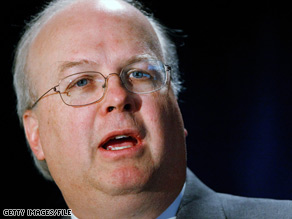
WASHINGTON (CNN) -- Karl Rove, President Bush's longtime political guru, refused to obey an order to testify before a House Judiciary Committee hearing Thursday.

Rove's lawyer asserted that Rove was "immune" from the subpoena the committee had issued, arguing that the committee could not compel him to testify due to "executive privilege."

The panel is investigating allegations that Rove and his White House allies dismissed U.S. attorneys and prosecuted officials who they saw as political opponents.

The panel subpoenaed Rove in May after his lawyer, Robert D. Luskin, made clear the former White House deputy chief of staff would not appear voluntarily.

Luskin responded immediately that Rove still would not appear, prompting a threat of prosecution from the Judiciary Committee chairman, Rep. John Conyers, a Michigan Democrat, and Rep. Linda Sanchez, a California Democrat who chairs the subcommittee on commercial and administrative law.

"A refusal to appear in violation of the subpoena could subject Mr. Rove to contempt proceedings, including statutory contempt under federal law and proceedings under the inherent contempt authority of the House of Representatives," Conyers and Sanchez wrote.

"We are unaware of any proper legal basis for Mr. Rove's refusal to even appear today as required by the subpoena," Sanchez said Thursday morning when Rove failed to show up. "The courts have made clear that no one -- not even the president -- is immune from compulsory process. That is what the Supreme Court rules in U.S. v. Nixon and Clinton v. Jones."

In May, Conyers contrasted Rove's refusal to testify before Congress with his paid work as a commentator for the Fox News Channel and Newsweek magazine.

"Although he does not seem the least bit hesitant to discuss these very issues weekly on cable television and in the print news media, Mr. Rove and his attorney have apparently concluded that a public hearing room would not be appropriate. Unfortunately, I have no choice today but to compel his testimony on these very important matters."

Rove's lawyer cited a letter from the Justice Department saying Rove is "constitutionally immune from compelled congressional testimony." He said Rove is willing to submit to an "informal interview" or to answer written questions about the prosecution of former Alabama Gov. Don Siegelman, whose ouster Rove is accused of orchestrating.

"Threatening Mr. Rove with sanctions will not in any way expedite the resolution of the issue," Luskin wrote in a letter to the panel on Wednesday.

Luskin noted in May that his client had already received a separate subpoena from the Senate Judiciary Committee. "While the [House] committee has the authority to issue a subpoena, it is hard to see what this will accomplish, apart from a 'Groundhog Day' replay of the same issues that are already the subject of litigation," the lawyer wrote, referring to a movie in which a person lives the same day over and over again.

Luskin added that "issues of executive privilege and separation of powers" could limit Rove's testimony.

In response, Conyers said the two committees are focusing on different matters, with the House committee delving into the prosecution of the former Alabama governor, a Democrat who lost his bid for re-election in 2002 and was convicted on corruption charges in 2006.

Conyers also noted that other former White House officials have testified under subpoena in the past and have dealt with issues of executive privilege on a case-by-case basis. "Mr. Rove should follow the same course," he said.

Rep. Lamar Smith of Texas, the top Republican on the House Judiciary Committee, called the subpoena "a sham."

The Democratic-controlled Congress has been battling for months to force the White House to disclose information about the firing of the attorneys and the prosecution of Siegelman.

Current and former White House aides have refused to testify, citing executive privilege.

Find this article at:
http://www.cnn.com/2008/POLITICS/07/10/rove.subpoena/index.html

Copyright 2008 Cable News Network

Tuesday, July 08, 2008

Iraq Wants Withdrawal Deadline

D'oh! I think someone at the White House forgot to get the talking points to Ali al-Dabbagh and Nuri al-Maliki. Will President Bush and Senator McCain permit Iraq to make their own decisions...even if it results in Iraq asking us to completely leave and a subsequent cozying up to Iran? Things that make you go...hummm?!

BAGHDAD, Iraq (CNN) -- A deadline should be set for the withdrawal of U.S. and allied forces from Iraq, and the pullout could be done by 2011, an Iraqi government spokesman said Tuesday.

Ali al-Dabbagh said any timetable would depend on "conditions and the circumstances that the country would be undergoing." But he said a pullout within "three, four or five" years was possible.

"It can be 2011 or 2012," al-Dabbagh said. "We don't have a specific date in mind, but we need to agree on the principle of setting a deadline."

Al-Dabbagh's comments come as the United States and Iraq try to negotiate a framework governing the stationing of U.S. and allied troops beyond the end of 2008, when the current U.N. mandate for coalition forces expires.

Al-Dabbagh said any such deal should include a withdrawal deadline. A day earlier, Prime Minister Nuri al-Maliki also said he favored a short-term accord that would spell out a withdrawal schedule for U.S. troops. VideoWatch report on how al-Maliki favors a timetable »

But in Washington, State Department spokesman Gonzalo Gallegos said U.S. negotiators are "looking at conditions, not calendars."

"Two things we've made very clear from the beginning of the process -- the first is that we're going to deal as sovereign nations working towards an agreement that satisfies both of our needs, and secondly that we're not going to be discussing individual parts of this negotiations during the negotiation process itself," Gallegos said.

Since taking control of U.S. Congress in 2007, Democrats have tried unsuccessfully to impose timetables for troop withdrawals. Some of the attempts were thwarted by filibusters from Republicans in the Senate.

Harry Reid, the Democratic leader of the U.S. Senate, told reporters: "I agree with Maliki."

"We should have a timeline. We've been wanting one for a long time," said Reid, D-Nevada.

Reid said it is time for the United States to "take off the training wheels and let Iraq handle their own affairs."

The Pentagon has repeatedly said conditions in Iraq including political and security milestones -- not timetables -- would guide whether the United States will remove troops. Those milestones include reduced levels of sectarian violence, political reconciliation and stronger Iraqi forces.

Republican presidential candidate John McCain said Tuesday the Iraqis have made clear that any withdrawal would be "based on conditions on the ground."

Maliki is "a politician," McCain told MSNBC. "He is a leader of a country that's finally coming together. The fact is that we and the Iraqis will deal in what is in the national security interests of both countries."

The United States is in the process of withdrawing the last of its five "surge" brigades -- those sent to Iraq in 2007 to bolster U.S. forces there. On Monday, Adm. Michael Mullen, the chairman of the U.S. Joint Chiefs of Staff, said violence in Iraq was down to its lowest point in four years and a decision whether to drop the number of troops below the level immediately preceding the surge would come later this year.

The Bush administration has been trying to strike a security deal with Iraq by the end of July, but disputes over the basing of U.S. troops and what authority they would have within Iraq make it unlikely an agreement will be reached by then, al-Dabbagh said.

"We still have our points of disagreement, and we are working on reaching the middle ground that will always guarantee us Iraq's sovereignty," al-Dabbagh said.

CNN's Saad Abedine and Mike Mount contributed to this report.

Find this article at:
http://www.cnn.com/2008/WORLD/meast/07/08/us.iraq/index.html

© 2008 Cable News Network

Sunday, July 06, 2008

U.S. condoned Kurdish oil deal: Contract contradicted Bush administration's public stance

Another likely example of the Bush Administration's difficulty with the truth, the whole truth, and nothing but the truth. So, help us God!

WASHINGTON - U.S. officials condoned Hunt Oil Co. efforts to obtain an exploration deal with Iraq’s Kurdish regional government, contrary to public statements discouraging it, according to documents cited by a congressional committee.

When the agreement was announced in September, it was criticized as undermining efforts to strengthen Iraq central government, which still had no national oil revenue-sharing law.

Bush administration officials expressed public concern and denied any knowledge of the contract.

On Wednesday, U.S. Rep. Henry Waxman released e-mails and letters obtained by the House Oversight and Government Reform Committee that appeared to show the opposite.

“Contrary to the denials of administration officials, advisors to the president and officials in the State and Commerce Departments knew about Hunt Oil’s interest in the Kurdish region months before the contract was executed,” Waxman, a California Democrat, wrote in a letter to Secretary of State Condoleezza Rice.

In one e-mail, Hunt Oil’s general manager wrote: “There was no communication to me or in my presence made by any of the 9 state department officials with whom I met ... that Hunt should not pursue our course of action leading to a contract. In fact, there was ample opportunity to do so, but it did not happen.”

Spokesmen for the State Department and Hunt Oil were not immediately available for comment.

State Department spokesman Tom Casey said Wednesday that “we continue to stand by our previous statements that the U.S. government made its objections to this arrangement known both to the company as well as to the KRG (Kurdistan Regional Government),” The Washington Post reported.

Waxman’s office released documents dating to June 2007, saying they raised questions about U.S. involvement in recently announced negotiations between the Iraqi government and major U.S. and multinational oil companies.

He told Rice he was seeking information about a possible U.S. role in the efforts of those companies to obtain Iraqi contracts.

“You and other administration officials have denied playing any role in these contracts. In the case of Hunt Oil, however, similar denials appear to have been misleading,” Waxman wrote.

The government of Iraq’s northern Kurdish region announced on September 8, 2007, that it had signed a gas and oil production sharing contract with a unit of Hunt Oil and with Impulse Energy Corp.

Hunt Oil Chief Executive Ray Hunt denied that his ties to the Bush family and the Republican Party helped his company cut a deal with the largely autonomous region.

Hunt said in a Wall Street Journal interview in October the company received no government advice before striking the deal.

“The fact is, as a matter of policy, we never have and never will go to the government of the U.S. and ask the government’s advice on anything we do from a business point of view,” he was quoted as saying.

Iraq has the world’s third-largest oil reserves, which are mainly in the north and the south of the country.

Kurdish officials have clashed with Baghdad over the national oil law, which will determine how contracts are awarded and how revenues are distributed. The northern Iraqi region has signed several exploration deals with foreign firms, which Baghdad says are illegal.

updated 3:20 a.m. CT, Thurs., July. 3, 2008

Copyright 2008 Reuters

URL: http://www.msnbc.msn.com/id/25506968/

© 2008 MSNBC.com

Tuesday, July 01, 2008

The Long Road to Forgiveness

I believe in the redemption of sins...


All Things Considered, June 30, 2008

On June 8, 1972, I ran out from Cao Dai temple in my village, Trang Bang, South Vietnam; I saw an airplane getting lower and then four bombs falling down. I saw fire everywhere around me. Then I saw the fire over my body, especially on my left arm. My clothes had been burned off by fire.

I was 9 years old but I still remember my thoughts at that moment: I would be ugly and people would treat me in a different way. My picture was taken in that moment on Road No. 1 from Saigon to Phnom Penh. After a soldier gave me some drink and poured water over my body, I lost my consciousness.

Several days after, I realized that I was in the hospital, where I spent 14 months and had 17 operations.

It was a very difficult time for me when I went home from the hospital. Our house was destroyed; we lost everything and we just survived day by day.

Although I suffered from pain, itching and headaches all the time, the long hospital stay made me dream to become a doctor. But my studies were cut short by the local government. They wanted me as a symbol of the state. I could not go to school anymore.

The anger inside me was like a hatred as high as a mountain. I hated my life. I hated all people who were normal because I was not normal. I really wanted to die many times.

I spent my daytime in the library to read a lot of religious books to find a purpose for my life. One of the books that I read was the Holy Bible.

In Christmas 1982, I accepted Jesus Christ as my personal savior. It was an amazing turning point in my life. God helped me to learn to forgive — the most difficult of all lessons. It didn't happen in a day and it wasn't easy. But I finally got it.

Forgiveness made me free from hatred. I still have many scars on my body and severe pain most days but my heart is cleansed.

Napalm is very powerful but faith, forgiveness and love are much more powerful. We would not have war at all if everyone could learn how to live with true love, hope and forgiveness.

If that little girl in the picture can do it, ask yourself: Can you?

This essay was produced by Anne Penman for the Canadian Broadcasting Corp. NPR's This I Believe is independently produced by Jay Allison and Dan Gediman with John Gregory and Viki Merrick. All material is copyright protected by Atlantic Public Media and This I Believe, Inc.

Sunday, June 29, 2008

Evangelical movement touts 'Jesus for president'

Spiritual misfits and rabble-rousers...sounds a lot like the prophets of old and the son of man?! When power speaks too many lies and wastes too many lives...the Lord calls to freaks to speak truth to power! Thanks be to God...


(Picture not from CNN)

By Eric Marrapodi and Kate Bolduan

PITTSBURGH, Pennsylvania (CNN) -- They're spiritual misfits. Rabble-rousers. They packed the shell of the old Baptist church on Negley Avenue in Pittsburgh, Pennsylvania, to hear author, Christian activist and fellow misfit Shane Claiborne stump on the campaign for a third party candidate, Jesus.

The dreadlocked Christian activist from Philadelphia and his team parked a black school bus around the back. The hand-painted gold letters on the side read "Jesus for President."

The bus runs on vegetable oil and, yes, it's a political statement.

"It'll be a long time before we fight a war over used veggie oil," says Claiborne with a sly smile.

Claiborne is touring the country, packing churches and community centers, in support of the book he and Chris Haw co-authored, "Jesus for President."

"This whole project is about the political imagination of what it means to follow after Jesus," Claiborne said. "The language of Jesus as Lord and savior is just as radical as it would be to say 'Jesus as our commander in chief' today."

Young evangelicals represent an important swing-voting bloc. They're not a lock for Republicans as their parents were. Their feet are firmly planted on issues dear to both parties. Traditional family values are, as they have been in the past, an important issue.

But these voters say views on abortion and homosexuality won't define them in November. The environment and social justice are moving to the forefront of their discussions.

About 26 percent of the United States identifies itself as evangelical Christians in the Protestant tradition, according to the latest U.S. Religious Landscape study by the Pew Forum on Religion and Public Life. In 2004, more than 75 percent of evangelicals cast their vote for George W. Bush.

"They delivered for him in some key states, like Ohio, without which he could not have won," said CNN's Bill Schneider, senior political analyst. "It was the rallying of the evangelical base that Karl Rove developed as a strategy, maximizing turnout among your base voters, not worrying about independents or swing voters."

But polls have shown that evangelicals as a whole, following national trends, are disaffected with Republican leadership and increasingly up for grabs.

Thursday was the fifth night of the tour and it has already seen hundreds show up in Grand Rapids, Michigan, and Indianapolis, Indiana.

It was a hot, muggy June day in Pittsburgh. About 250 people came through the doors to find there was no air conditioning in the old church-turned-community center. They ran out of chairs so people took to the floors and leaned against the walls.

There were voters from across the board: Republicans, Democrats and independents. Most were young, Christian by background, evangelical in theology, and they say they're hungry for something more than partisan politics.

Steph Walker and Amanda Widing had to settle for seats in the back.

"I would say that social justice and issues like that have definitely arisen as an important part of my faith and, because of that, it affects how I vote and think of those things definitely," said 21-year-old Walker.

She grew up in a Republican household but has switched parties and will vote for Sen. Barack Obama in November.

Widing, 20, is a registered Republican but unsure who she'll vote for.

"There are certain issues where I identify more with Republicans and other issues where I identify more with Democrats, so I really am completely undecided at this point," she said.

Eric Sapp is a founding member of the Eleison group focused on getting people of faith out to the polls for Democrats. He sees younger evangelicals as prime targets to swing.

"These voters are starting to become independent swing voters instead of a lock for either party," Sapp said. "For Democrats, also, it's a successful place because when a group had been voting four out of five Republican and they start becoming a swing constituency that also has significant electoral implications."

Back on stage Claiborne takes the crowd through a multimedia presentation.

"With the respectability and the power of the church comes the temptation to prostitute our identity for every political agenda."

Controversially, he quotes Harry S. Truman and Adolph Hitler, saying each used Christianity to support their ideologies.

The speech is fiery at times, pensive at others. It emphasizes caring for the poor and the downtrodden.

He talks about war and the environment. He also talks about how Jesus stood up to the Roman Empire, a message he believes is relevant to the United States now.

"For many of us, Caesar has colonized our imagination, our landscape and our ideology," he says while a picture of Mount Rushmore flashes behind him. On the screen "Vandalism" pops up in black letters.

Trading lines back and forth from a script with Haw, they save the most wrath for Christians who they say have missed the point of the cross.

"We've profaned the blood at the foot of the cross and turned it into Kool-Aid and marketed it all over the world. We'll make an art and a business out of taking the Lord's name in vain," Claiborne says as images of Christ on the cross and the American flag flash behind him.

They endorse no candidate and make no effort to sway the voters for one party or another.

After the speech in an interview with CNN, Claiborne said, "This is not about going left or right, this is about going deeper and trying to understand together. Rather than endorse candidates, we ask them to endorse what is at the heart of Jesus and that is the poor or the peacemakers and when we see that then we'll get behind them."

Claiborne says the movement of younger evangelicals is growing and looking at the Bible in more holistic terms. He is quick to say the call of Christ has more to do with how people live their lives on November 3 and 5 than how they vote on November 4.

"It's certainly easy to walk into a voting booth every four years and feel like you're going to change the world but that's not going to do it."

After the interview, Claiborne, Haw and the band pack up and head to a local restaurant in search of more grease to power the bus. They find it at a Chinese restaurant a few miles away.

At 11 p.m. they're on the road again. They drive through the night to Washington, sleeping in the retrofitted bunks in the back of the school bus.

The next night in the nation's capital they hit the stump again, calling for young evangelicals to vote "Jesus for President."

http://www.cnn.com/2008/POLITICS/06/29/evangelical.campaign/index.html?eref=rss_topstories

© 2008 Cable News Network

Wednesday, June 25, 2008

Five FEC nominees finally confirmed by Senate

It is about freakin' time! What do you get when you combine the worst qualities of an elephant and a donkey? A whole lot of crap!


WASHINGTON (AP) — The Senate on Tuesday confirmed five nominees for the Federal Election Commission, breaking a prolonged partisan logjam and allowing the agency to resume functioning.

The nominees were confirmed without dissent after drawn-out talks between Senate Majority Leader Harry Reid, D-Nev., and Republican leader Mitch McConnell of Kentucky, and a last-minute hang-up over a demand from Sen. Russ Feingold, D-Wis., a campaign finance crusader, to meet with all five nominees.

Though the FEC staff has been at work, the six-member commission has been inactive because it has not had a quorum to conduct business. The commission is the agency that regulates federal elections and campaign finance matters.

"Our nation's campaign finance watchdog was off the beat," Reid said.

The newly confirmed commissioners are Democrats Cynthia L. Bauerly of Minnesota and Steven T. Walther of Nevada, along with Republicans Caroline C. Hunter of Florida, Donald F. McGahn of the District of Columbia and Matthew S. Petersen of Utah.

McConnell called the action "long overdue," adding that the agency "can now resume its critical role of enforcing election laws and ensuring that this election season is fair and equitable to all who are involved."

A key breakthrough came last month when the White House nominated Petersen, the Republican chief counsel on the Senate Committee on Rules and Administration, to the commission, replacing another candidate who withdrew after coming under Democratic fire.

Petersen replaced Hans von Spakovsky, a former Justice Department official whose oversight of voting rights matters had angered Democrats. Von Spakovsky served on the FEC under a recess appointment.

The commission consists of three Democratic and three Republican appointees. Any commission action requires a four-vote majority, no matter what size the quorum.

Since the beginning of the year, the commission has only had two members: Republican Chairman David Mason and Democrat Ellen Weintraub.

Earlier this month, President Bush decided to withdraw Mason's nomination, prompting a protest from Reid and from watchdog groups.

Mason has on few occasions voted with Democrats on regulatory matters. Earlier this year, he angered officials in Republican John McCain's presidential campaign by raising questions about a loan McCain obtained and by informing the campaign that it needed a vote of the commission before withdrawing from the primary's public financing system. Earlier this year, the Democratic National Committee filed a complaint with the FEC over McCain's loan and on Tuesday it sued in federal court to compel the FEC to investigate the matter.

McCain has another matter before the commission. He plans to accept $85 million in public money for his general election campaign — a step that requires the approval of the commission. Without an operating FEC, McCain would be unable to collect the money.

The FEC faces unfinished business that includes final action on regulations governing candidate air travel as well as new rules on lobbyist fundraisers and joint advertising by national parties and federal candidates.

http://politicalticker.blogs.cnn.com/2008/06/24/five-fec-nominees-confirmed-by-senate/


© 2008 Cable News Network LP, LLLP. A Time Warner Company. All Rights Reserved.


Powered by ScribeFire.

Friday, June 20, 2008

The Four Agreements

I really like the premise of this article...simple and common-sensible.

Our agreements with ourselves determine how we behave, what we believe is possible and impossible. We have many agreements with ourselves, the only problem is many of these agreements go against us. Self-limiting beliefs rob us of our freedom. We can blame the state of our lives on others, society, or our environment, but we will never be free unless we take responsibility for own freedom.

The agreements you’ve made with yourself can either be an elevator or a cage. Our doubts and fears are not true in themselves. Our deepest beliefs about ourselves and the nature of our world are not true in themselves, but our thinking makes them true in our experience. We can change our thinking and change even our deepest core beliefs.

In the book The Four Agreements, Don Miguel Ruiz offers four simple suggestions to change the agreements we have with ourselves, and recover our personal freedom.

1. Be impeccable with your word.

What does impeccable mean? It means to be without sin (no I don’t mean not committing adultery or coveting your neighbor’s bmw). If you look up the root of sin, you’ll find that it means “to go against.” Being impeccable with our word means we don’t use our word against ourselves. If we don’t like what someone else has to say, we can walk away. But if we don’t like what we have to say to ourselves, we can’t walk away. Doesn’t it make more sense to use our word to go with ourselves, instead of against us? Just with this first agreement alone, we can transform our relationship with ourselves.

2. Don’t take anything personally.

We all have a feeling of “personal importance.” We think that when others do something, it has to do with us. In reality, others actions are based on their own internal world. When we realize that nothing others do has anything to do with us, we become immune to their words and actions. Even if someone shot you in the head, it was nothing personal. It had nothing to do with you, it was because of their own beliefs and fears.

3. Don’t make assumptions.

How many times we do we get upset at our loved ones or friends when they do something that offends us. We think “they should have known.” The truth is, no one knows the contents of our minds. When we make assumptions, we create a whole lot of unnecessary drama. Instead we can ask questions, and have the courage to tell others how we feel. If you’re not sure of how another person feels, ask them. If we have the courage to ask others questions and be open with our feelings, we can save a lot ourselves a lot of pain and suffering.

4. Always do your best.

Realize that your best will be different depending on different circumstances. When you’re healthy your best will be better than when you’re sick. Whatever your situation, always do your best. The first three agreements are about changing your agreements with yourself. The fourth agreement is about putting them into action. If you always do your best, you can free yourself from the judge and the victim in your mind. Even if you fail, you’ll know at least you did your best.

Learning From Great Teachers

Whether they knew it or not, many great thinkers and teachers followed these agreements to some degree. Thomas Edison proclaimed “Hell, there are no rules here– we’re trying to accomplish something.” He knew that if there were too many rules, their creativity would be limited.

Gandhi was a master of not taking things personally. He knew that if he responded with violence, he would only promote more violence. He was able to see that their oppression was the result of their own beliefs, their own agreements.

When I think of someone who didn’t make assumptions, Jesus Christ immediately comes to mind. He didn’t judge others for their actions, he had the courage to ask questions and clarify his beliefs.

Albert Einstein knew that if he failed, there was simply another incorrect possibility eliminated. He could have easily become frustrated and given up. But he used the power of his word to go with himself.

Returning to Uncommon Sense

Most of these agreements might seem like common sense at first glance. But they are entirely the opposite. They are uncommon sense. When I first read this book, I thought “My god, how could I have not realized this before?” It’s so deceptively simple.

Implementing these agreements into your life, on the other hand takes hard work. Make the agreement to practice them just today. The more we practice these agreements, the more we’ll regain our personal freedom. We’ll unclutter our inner world save ourselves a lot of drama. Not only with ourselves, but with others as well.

By practicing these agreements, we can chip away at all the self-defeating beliefs we’ve created within us. We can recover our personal freedom.

Copyright Illuminated Mind 2008 | Design by Jonathan Mead

Original article here.

Wednesday, June 18, 2008

On the Church Bulletin...


The resurrection is an event of its own kind, occurring in history yet defying the current canons of the study of history; it is, in the full sense of the words, an act of God. If it did not happen, Christian faith is false and the Christian lives out a lie; since it did happen, all our standards of judgment, and we ourselves, are profoundly called into question, but Christ is fully alive, and there is hope for us who can wonder, doubt -- and believe.

James William McClendon, Jr.
(1924-2000)

Tuesday, June 17, 2008

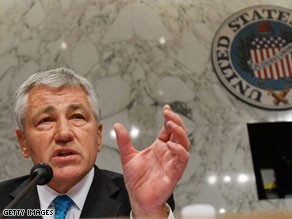
Republican Chuck Hagel a good choice for Obama V.P.?

I think Jack Cafferty may be on to something here...but, is it something that Senator Obama is capable of hearing? We'll see.


Posted: 02:22 PM ET
FROM CNN’s Jack Cafferty:

Barack Obama has already made history in this campaign, but what if he does it one more time by picking a Republican as his V.P.?

Salon.com reports about the buzz surrounding GOP Sen. Chuck Hagel of Nebraska as a potential choice for Obama. Hagel admittedly is a long shot for the job. Just imagine the symbolism: Obama could truly hit home the message that he’s serious about changing the way Washington works by running with a Republican.

And there’s no better Republican for him to run with than Chuck Hagel. Hagel is retiring at the end of his term. He has been very tough on President Bush when it comes to the war in Iraq. Last year, Hagel said that Bush was “not accountable anymore” and that “before this is over, you might see calls for his impeachment.” Hagel was also recently critical of his longtime friend, John McCain… particularly some of McCain’s comments about Iran. Hagel said he thinks McCain “is smarter than some of the things he is saying.”

The article points out that although many tout Hagel as a moderate Republican who’s willing to reach across the aisle, he’s still a conservative. And there’s the rub. Former Sen. Bob Kerrey, a Democrat and friend of Hagel’s, says it would be hard to imagine his party backing someone who’s anti-choice, anti-civil rights for gays and anti-gun control, adding “It’s not impossible, but it’s bumping right up on the edge.”

For his part, Hagel has yet to endorse John McCain. It’s been reported that Hagel’s wife gave Obama $500 in February. And, in a CNN interview last month, Hagel himself laughed off a question about being Obama’s running mate, but he didn’t rule it out saying he’s “going to try and find some honest work.”

Here’s my question to you: What message would it send if Barack Obama picked Republican Chuck Hagel as V.P.?

© 2008 Cable News Network LP, LLLP. A Time Warner Company. All Rights Reserved.

Thursday, June 12, 2008

476 F. 3d 981, reversed and remanded.

Boo Yeah! Not so fast Mr. Bush...looks like your unitary, tyrannical powers just got checked! Blessed be the Supreme Court of the United States of America. Habeas Corpus is no longer resting in peace! Live free or die! Speak truth to power!


Syllabus

KENNEDY, J., delivered the opinion of the Court, in which STEVENS, SOUTER, GINSBURG, and BREYER, JJ., joined. SOUTER, J., filed a concurring opinion, in which GINSBURG and BREYER, JJ., joined. ROBERTS, C. J., filed a dissenting opinion, in which SCALIA, THOMAS, and ALITO, JJ., joined. SCALIA, J., filed a dissenting opinion, in which ROBERTS, C. J., and THOMAS and ALITO, JJ., joined.


Teen Shot, Killed In Hunting Accident by Grandfather with AK-47

W.T.F?! Why in the hell would you go hunting with an AK-47 assault rifle? That is not sport. That is not game. That is not honoring the spirit of the hunt. That is not stewardship of creation. What a waste...sigh.


LAVACA COUNTY, Texas -- A 14-year-old boy was accidentally shot and killed in a hunting accident by his grandfather, investigators said.

According to the Lavaca County Sheriff's Office, Taylor Michalec's grandfather said he was walking behind the teen when the trigger on his AK-47 assault rifle snagged a branch and discharged, striking the teen in the back.

The shooting happened Wednesday afternoon near County Road 290, about five miles west of Moulton, Texas, about 100 miles east of San Antonio.

Both his father and grandfather tried to administer CPR, but when EMS responders arrived, the teen was pronounced dead. Michalec had just completed his freshman year at Steele High School, where he was a member of the football team.

Lavaca County investigators said they will not file any charges on the boy's grandfather because the shooting appeared to be an accident.

POSTED: 3:36 pm CDT June 12, 2008
UPDATED: 5:47 pm CDT June 12, 2008

Copyright 2008 by KSAT.com All rights reserved.

4 teens remembered as model Scouts

I post this simply to honor the fallen...no other words.


(CNN) -- Four Boy Scouts who died Wednesday when a tornado swept through a wilderness camp were remembered for the very qualities that had brought them to the camp in the first place.

Josh Fennen, 13, Sam Thomsen, 13, Ben Petrzilka, 14 , and Aaron Eilerts, 14, were among 93 Boy Scouts who were chosen by their troop leaders to attend leadership training this week at the Little Sioux Scout Ranch outside Omaha, Nebraska.

In addition to the deaths, 48 scouts and staff members were injured.

Friends and relatives on Thursday described the fallen scouts as multitalented, dedicated teens whose enthusiasm for life was matched only by their passion for scouting.

As a member of the Humboldt Boy Scout Troop No. 108 in Eagle Grove, Iowa, Aaron Eilerts used his own money to make pillowcases for hospital patients, according to a story that was published in the Eagle Grove Eagle last year.

He tried to donate the pillowcases to hospitals during a family vacation to Memphis, where he visited the home of Elvis, one of his heroes, the newspaper said in an article that was reprinted Thursday.

Aaron extended the same dedication to making fleece blankets for the Humane Society, according to the Omaha World-Herald.

"He embodied everything Scouting stands for," Dawn Sievertsen, principal of Robert Blue Middle School in Eagle Grove, Iowa, told the newspaper. "He would start these projects to earn badges, but took them very seriously and would continue them long after he earned the badge."

People who knew Josh Fennen of Omaha said he used many of the skills he learned in scouting in everyday life.

"We'd go hiking. He was a good hiker. He knew what to do, how to start fires and good with pocketknives," Josh's best friend, Jack Cormaci, told affiliate KETV. "He'd always be there when you needed him, always playing outside."

Jeff Alfrey, the principal at Andersen Middle School, where Josh recently finished eighth grade, described Josh as inquisitive and confident, with natural leadership qualities, according to the Omaha World-Herald.

"He was a good student, a hard worker, and he was always trying to be creative," Alfrey told the newspaper.

Sam Thomsen, who was days away from his 14th birthday, divided his time among the Boy Scouts, sports, home-schooling and the Southwest Church of Christ, according to the Omaha World-Herald.

Sam's Facebook page, where he last wrote, "Sam is ready for a week in the great outdoors," lists his interests as Jesus, football, video games and the Roadrunners, a basketball team for home-schooled children, according to the newspaper.

"He's just a great kid," Dr. Jim White, pastor of Southwest Church of Christ, told the newspaper. "He was a typical teenager, always has a smile on his face. He was just a joy to be around."

Ben Petrzilka, who just finished seventh grade at Mary Our Queen Catholic School, was remembered as kind and caring.

"He always gave it his best effort. It is a very devastating loss to the school," principal Kayleen Wallace told the newspaper.

A candlelight vigil was scheduled for Thursday evening at the Durham Scout Center in Omaha, the Boy Scouts said.

Find this article at:
http://www.cnn.com/2008/US/weather/06/12/scouts.tornado/index.html

© 2008 Cable News Network

Wednesday, June 11, 2008

What song is this?


Now that is quite impressive!

Website Lets Christians E-Mail Friends After Rapture

I have to thank my pastor, Stan Wilson, for letting me know about this important communication tool. I told him that he should put me on his list so that I can cover at church for him. I am sure that most of the members will still be around!


Christians who believe they might one day be physically swept up to heaven in the Rapture will be able to send e-mails to loved ones left behind on Earth nearly one week after the apocalyptic event takes place, thanks to a new website.

YouveBeenLeftBehind.com lets subscribers send an e-mail message to up to 62 people exactly six days after they've disappeared from the face of the Earth, Wired Magazine's Threat Level reports.

The website, run by Mark Heard along with four other Christians, dispatches the e-mails when at least three staff members fail to log in for six consecutive days. Its main purpose is to give Christians one final shot at evangelism.

"You've Been Left Behind gives you one last opportunity to reach your lost family and friends for Christ," states the website.

The site is predicated on one interpretation of Christian theology that puts the day of Rapture as the beginning of The End Times or Armageddon. Believers, according to this viewpoint, would be physically lifted up to heaven while those who have not accepted Christ would be left behind to suffer seven years of Tribulation under a global government headed by the Antichrist.

In addition to the e-mail function, users of YouveBeenLeftBehind.com can also store personal and financial documents on the site. Up to 150 megabytes of information would be sent to up to 12 people after the presumed rapture.

"In the encrypted portion of your account you can give them access to your banking, brokerage, hidden valuables, and powers of attorneys," explains the site.

"There won't be any bodies, so probate court will take seven years to clear your assets to your next of kin. Seven years, of course, is all the time that will be left. So, basically the Government of the Antichrist gets your stuff, unless you make it available in another way."

The services offered by the site cost $40 a year. Heard told Threat Level that he already has paying subscribers.

Some Christians have praised the idea.

"I do believe in the rapture. As far as the website goes I think it’s a great idea, because if you believe in the rapture (like me), you know that the time remaining on earth is short and is going to be the worst days the world has known. However, those left behind still will have the opportunity for salvation which is the message I would want to get across," wrote one Christian identified as "skinthemboys" on a forum site for Washington Redskins football fans.

But the site also has plenty of critics that include both Christian and non-Christian bloggers. Some call the site "ridiculous" and "disgusting."

"In a world where only 16% of 16 to 29-year-old non-Christians express favorable view of Christians (Barna, 2007) , and only 3% of 16 to 29-year-old nonChristians express favorable views of evangelicals... we Christians should try to avoid doing stupid stuff like this," vents Jonathan McKee, president of The Source for Youth Ministry, on his blog.

Heard told Threat Level that he has politely responded to some of the site's critics and has turned their negative comments into "constructive criticism" for improvements to the site.

Elena Garcia
Christian Post Reporter
Sun, Jun. 08, 2008 Posted: 11:55:48 AM EST

Tuesday, June 10, 2008

Obama beats back criticism over head of VP search

Mr. Obama, you must always speak truth to power...even if you are that power. Jesus said, "Why do you see the speck in your brother's eye but fail to notice the beam in your own eye?" Matthew 7:3. I personally do not expect perfection...only your best! Yes, you can...speak truth to power!


(CNN) – Barack Obama on Tuesday brushed aside the notion that the head of his vice presidential search committee, Jim Johnson, contradicts the campaign's message because he has received favorable loans from Countrywide Financial — one of the companies at the center of the nation's mortgage crisis.

"I am not vetting my VP search committees for their mortgages," Obama said during a press conference in St. Louis, Missouri. "I mean this is a game that can be played — everybody you know who is anybody who is tangentially related to our campaign I think is going to have a whole host of relationships."

The comments come two days after the Wall Street Journal reported that Johnson was the recipient of over $7 million worth of home loans from Countrywide, made available through a program for friends of the company's chief executive officer.

Countrywide has taken a big hit during the current subprime loan crisis. Obama has often taken aim at the practice of issuing subprime loans.

The Republican National Committee immediately seized on that report, saying Johnson's appointment "raises serious questions about Obama’s judgment." Presumptive Republican nominee John McCain also criticized Obama, saying Monday that Johnson’s role "suggests a bit of a contradiction, talking about how his campaign is going to be not associated with people like that."

Obama tapped Johnson, a longtime Washington insider, to head his vice-presidential search late last month. Johnson held the same role for then-Democratic Presidential Candidate John Kerry in 2004. He has long been known for keeping a low profile while holding some of Washington's most powerful posts, including heading up mortgage giant Fannie Mae and the Brookings Institution.

Johnson is currently a vice chairman of Perseus LLC, a private banking firm.

Speaking to reporters on Tuesday, Obama suggested Johnson's past loans are irrelevant to his current position with the campaign.

At some point you know we just asked people to do their assignments," he said. "These aren't folks who are working for me. They are not people you know who I have assigned to a job in the future administration, and ultimately my assumption is that this is a discreet task that they are going to performing for me in the next two months."

McCain spokesman Tucker Bounds said it is "preposterous" for the Illinois senator to claim Johnson isn't working for him.

"Barack Obama has castigated Countrywide Financial, but now that Jim Johnson has been exposed for taking sweetheart deals from Countrywide’s CEO — Obama is in a state of denial," Bounds said. "It’s that brand of weak leadership and hypocrisy that shows why Barack Obama has no record of taking courageous stands or making change in Washington.”

June 10, 2008
Posted: 01:00 PM ET
From CNN PoliticalTicker Producer Alexander Mooney

© 2008 Cable News Network LP, LLLP. A Time Warner Company. All Rights Reserved.

Kucinich introduces Bush impeachment resolution

I wish to be officially on record in support of the impeachment of President Bush. My previous blog posts will serve as my own justification for this severe, yet constitutionally, proscribed legal remedy. Our Republic means nothing if we allow the actions and crimes of George Bush to stand without sanction. Come on my fellow Republicans and Democrats...don't be so feckless and do what your job requires of you!


WASHINGTON (CNN) — Rep. Dennis Kucinich, a former Democratic presidential candidate from Ohio, introduced a resolution to impeach President Bush into the House of Representatives Tuesday, having the clerk of the House read the 35-article document in its entirety.

Kucinich, who last year introduced a resolution to impeach Vice President Dick Cheney, announced his intention to seek Bush’s impeachment Monday night when he also read the lengthy document into the record.

House Speaker Nancy Pelosi has repeatedly said she would not support a resolution calling for Bush’s impeachment, saying such a move was unlikely to succeed and would be divisive.

Most of the congressman’s resolution deals with the Iraq war, contending that the president manufactured a false case for the war, violated U.S. and international law to invade Iraq, failed to provide troops with proper equipment and falsified casualty reports for political purposes.

Kucinich also charges that Bush has illegally detained without charge both U.S. citizens and “foreign captives” and violated numerous U.S. laws through the use of “signing statements” declaring his intention to do so.

The CNN Wire
June 10th, 2008
Posted: 10:29 PM ET

© 2008 Cable News Network LP, LLLP. A Time Warner Company. All Rights Reserved.

Sunday, June 08, 2008

‘Anything Not to Go Back’ to Iraq

Even a "good" or "necessary" war (if such a thing really exists) is physically and emotionally violent; but, when that violence is combined with a growing awareness and realization that the current war in Iraq is neither good nor necessary, the distress and fear can be too great to handle...even for the great American soldier. I hope you feel this distress and fear too, Mr. Bush! This is the reality of war; this is why I follow in the Way of a Peacemaker. Speak truth to power!


By Tony Dokoupil
NEWSWEEK
Updated: 12:12 PM ET Jun 7, 2008

As an internist at New York's Mount Sinai Hospital, Dr. Stephanie Santos is used to finding odd things in people's stomachs. So last spring when a young man, identifying himself as an Iraq-bound soldier, said he had accidentally swallowed a pen at the bus station, she believed him. That is, until she found a second pen. It read 1-800-GREYHOUND. Last summer, according to published reports, a 20-year-old Bronx soldier paid a hit man $500 to shoot him in the knee on the day he was scheduled to return to Iraq. The year before that, a 24-year-old specialist from Washington state escaped a second tour of duty, according to his sister, by strapping on a backpack full of tools and leaping off the roof of his house, injuring his spine.

Such cases of self-harm are a "rising trend" that military doctors are watching closely, says Col. Kathy Platoni, an Army Reserve psychologist who has worked with veterans of Iraq and Afghanistan. "There are some soldiers who will do almost anything not to go back," she says. Col. Elspeth Ritchie, the Army's top psychologist, agrees that we could see an uptick in intentional injuries as more U.S. soldiers serve long, repeated combat tours, "but we just don't have good, hard data on it." Intentional- injury cases are hard to identify, and even harder to prosecute. Fewer than 21 soldiers have been punitively discharged for self-harm since 2003, according to the military. What's worrying, however, is that American troops committed suicide at the highest rate on record in 2007—and the factors behind self-injury are similar: combat stress and strained relationships. "It's often the families that don't want soldiers to return to war," says Ritchie.

Soldiers have long used self-harm as a rip cord to avoid war. During World War I, The American Journal of Psychiatry reported "epidemics of self-inflicted injuries," hospital wards filled with men shot in a single finger or toe, as well as cases of pulled-out teeth, punctured eardrums and slashed Achilles' heels. Few doubt that the Korean and Vietnam wars were any different. But the current war—fought with an overtaxed volunteer Army—may be the worst. "We're definitely concerned," says Ritchie. "We hope they'll talk to us rather than self-harm."

URL: http://www.newsweek.com/id/140478

© Newsweek 2008

Wednesday, June 04, 2008

A Response to Cal Thomas' Assertion that "Barack Obama Is Not a Christian"

Ah yes, the Joy of Cal Thomas! I do not find Cal Thomas to be an evil man...I have agreed with some of the things he has said in the past; however, his recent blog post (full text below) on The Fox Forum neatly captures the pitfalls of fundamentalism. No one will ever be morally clean enough or doctrinally pure enough to satisfy the insatiable appetite for souls and reputations that modern day Pharisees live off of! And, in the end, doctrine and pure faith are not really what fundamentalists seek…they are seeking power for themselves in an effort to militaristically impose a false gospel of might makes right and divisiveness onto those who have already been abused by sin and ruined by religious hypocrisy.

On the contrary, our true gospel rejects fear, demands selfless giving even to the point of death, elevates love to the highest level of character and motive, embraces sinners, sounds the call to social justice, speaks truth to power and to self, makes disciples that know and live all of the words of Jesus, judges actions and fruit rather than doctrinal distinctives and flashy foliage, struggles towards redemption, encourages us to work out our salvation with fear and trembling, and cares more for the one lost than the 99 saved.

I have one Lord whom I personally call Jesus. My knee bends only to him. I do not embrace our political leaders as my religious instructors and do not expect them to fit my enigmatic belief structure. We are not calling a pastor to serve and equip the flock, we are electing a president to execute the laws of the nation according to our Constitution. To be completely honest, I currently doubt whether a disciple can be equally faithful to Jesus and to the American flag. There is only one rule and realm of life that we can seek first…so I will seek the rule and realm of a gracious God and his faithful son, and then give to Caesar that which is Caesar’s.

Finally, I wonder if Cal Thomas, and those of his ilk, are willing to allow others to pick their faith and actions to pieces like vultures on a carcass. I know that I could not stand-up to such…my heresies are numerous and my feet are fissured clay! What president would he like to bring forth as our exemplar for Preacher and Priest-in-Chief? Ronald Regan…who heard counsel from his wife’s astrologer and divorced his first wife? Of course not Bill Clinton…who tried to mount everything that moved; but, publicly confessed his sin once caught in the snare of his lies. What about the great General Eisenhower…oops, he kept a mistress and warned about the tyranny of military-industrial power. President Lincoln was a man of faith and action…but during the Civil War he egregiously circumvented the Bill of Rights and expressed distrust of the profiteering capitalists of industry and their trampling of the poor workers. The great defender of religious liberty, Thomas Jefferson, sired children with a slave and pen-knifed the miracles of Jesus out of his Bible. Do the deistic, Masonic doctrinal distinctives of George Washington negate the service, character, and greatness of our first president? Sheesh...

Speak Truth to Power!


By Cal Thomas
Posted on Monday, June 2nd, 2008 at 4:14 pm
Syndicated columnist/FOX News Contributor

Religion is a topic that makes most journalists uncomfortable, unless they can expose hypocrisy — as in preachers who speak of virtue while carrying on an affair — or outrage such as Rev. Jeremiah Wright and the doings at Barack Obama’s now former church in Chicago. Most journalists think taking religion seriously might require them to study the claims of various faiths and too many of them have already decided this might lead them to a faith higher than themselves or politics and they don’t wish to take such a journey of personal discovery.

That is too bad, because such an attitude exposes one of the main gaps between most Americans — who believe in God — and most journalists, who don’t.


An exception is Chicago Sun-Times columnist Cathleen Falsani, who interviewed Obama in 2004 for her book, “The God Factor: Inside the Spiritual Lives of Public People “and asked him specific questions about his religious beliefs.

“I’m rooted in the Christian tradition,” said Obama, who has declared himself a Christian. But then he adds something that most Christians will see as universalism: “I believe there are many paths to the same place, and that is a belief that there is a higher power, a belief that we are connected as a people.”

Falsani correctly brings up John 14:6 (and how many journalists would know such a verse, much less ask a question based on it?) in which Jesus says of Himself, “I am the way and the truth and the life. No one comes to the Father except through me.” That sounds pretty exclusive, but Obama says it depends on how this verse is heard. According to Falsani, Obama thinks that “all people of faith — Christians, Jews, Muslims, animists, everyone — know the same God.” (her words)

If that is so, Jesus wasted his time coming to Earth and he certainly did not have to suffer the pain of rejection and crucifixion if there are ways to God other than through Himself.

Here’s Obama telling Falsani, “The difficult thing about any religion, including Christianity, is that at some level there is a call to evangelize and proselytize. There’s the belief, certainly in some quarters, that if people haven’t embraced Jesus Christ as their personal savior, they’re going to hell.” Falsani adds, “Obama doesn’t believe he, or anyone else, will go to hell. But he’s not sure he’ll be going to heaven, either.”

Here’s Obama again: “I don’t presume to have knowledge of what happens after I die. When I tuck in my daughters at night and I feel like I’ve been a good father to them, and I see that I am transferring values that I got from my mother and that they’re kind people and that they’re honest people, and they’re curious people, that’s a little piece of heaven.”

Any first-year seminary student could deconstruct such “works salvation” and wishful thinking. Obama either hasn’t read the Bible, or if he has, doesn’t believe it if he embraces such thin theological gruel.

Obama can call himself anything he likes, but there is a clear requirement for one to qualify as a Christian and Obama doesn’t meet that requirement. One cannot deny central tenets of the Christian faith, including the deity and uniqueness of Christ as the sole mediator between God and Man and be a Christian. Such people do have a label applied to them in Scripture. They are called a “false prophet.”

I hope some national journalist or commentator with knowledge of such things asks Obama about this and doesn’t let him get away with re-writing Scripture to suit his political ends.

http://foxforum.blogs.foxnews.com/2008/06/02/barack-obama-is-not-a-christian/

© 2008 FOX News Network, LLC. All rights reserved.

Tuesday, June 03, 2008

Mississippi Country Roads

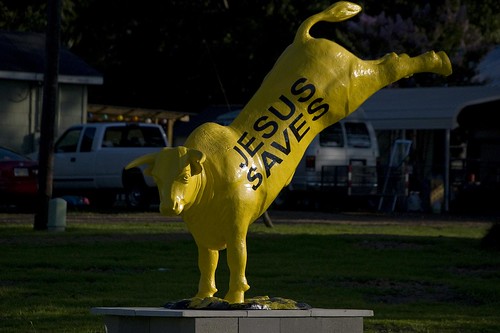
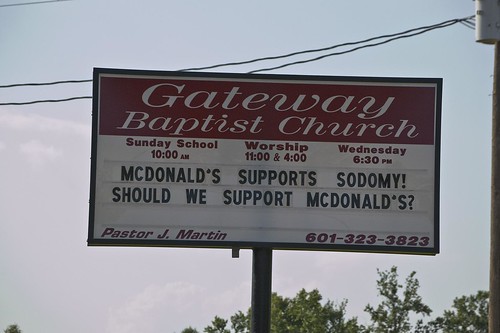
Today, my friend Chris and I drove the back roads from Jackson, MS to Ellisville, MS for a Make-A-Wish Foundation of Mississippi news conference. Along the way, we saw some beautiful rural scenery; but also some amazingly disturbing and provocative examples of religious expression...at least in our opinion. I wonder how Alexis de Tocqueville would muse about the state of American faith and polity today?! Chris and I would like to share our pictorial discoveries with you.


Did Aaron's golden calf grow up?


Yes, I would like a Happy Meal and could you please sodomize the fries, please.


Also, be prepared to stop for people preparing to meet their God!


This is just plain wrong?! Sheesh! If you knew baptists like I knew baptists, you would be experiencing shock and awe!


Thanks again, Chris, for providing the pictures on your Flickr Photostream! Any rights associated with these pictures are reserved by Chris Kennedy.

Sunday, June 01, 2008

How to harvest solar power? Beam it down from space!

Man, this is way out cool! Don't freak out...think it out!


LONDON, England (CNN) -- Jyoti is the Hindi word for light. It's something Pranav Mehta has never had to live without. And he is lucky. Near where he lives in Gujarat, one of the most prosperous states in India, thousands of rural villages lack electricity or struggle with an intermittent supply at best.

"We need to empower these villages, and for empowerment, energy is a must," Mehta said. "Rural India is suffering a lot because of a lack of energy."

By 2030, India's Planning Commission estimates that the country will have to generate at least 700,000 megawatts of additional power to meet the demands of its expanding economy and growing population.

Much of that electricity will come from coal-fired power plants, like the $4 billion so-called ultra mega complex scheduled to be built south of Tunda Wand, a tiny village near the Gulf of Kutch, an inlet of the Arabian Sea on India's west coast. Dozens of other such projects are already or soon will be under way.

Yet Mehta has another solution for India's chronic electricity shortage, one that does not involve power plants on the ground but instead massive sun-gathering satellites in geosynchronous orbits 22,000 miles in the sky.

The satellites would electromagnetically beam gigawatts of solar energy back to ground-based receivers, where it would then be converted to electricity and transferred to power grids. And because in high Earth orbit, satellites are unaffected by the earth's shadow virtually 365 days a year, the floating power plants could provide round-the-clock clean, renewable electricity.

"This will be kind of a leap frog action instead of just crawling," said Mehta, who is the director of India operations for Space Island Group, a California-based company working to develop solar satellites. "It is a win-win situation."

American scientist Peter Glaser introduced the idea of space solar power in 1968.

NASA and the United States Department of Energy studied the concept throughout the 1970s, concluding that although the technology was feasible, the price of putting it all together and sending it to outer space was not.

"The estimated cost of all of the infrastructure to build them in space was about $1 trillion," said John Mankins, a former NASA technologist and president of the Space Power Association. "It was an unimaginable amount of money."

NASA revisited space solar power with a so-called "Fresh Look" study in the mid-90s but the research lost momentum when the space agency decided it did not want to further pursue the technology, Mankins told CNN. By around 2002 the project was indefinitely shelved -- or so it seemed.

"The conditions are ripe for something to happen on space solar power," said Charles Miller, a director of the Space Frontier Foundation, a group promoting public access to space. "The environment is perfect for a new start."

Skyrocketing oil prices, a heightened awareness of climate change and worries about natural resource depletion have recently prompted a renewed interest in beaming extraterrestrial energy back to Earth, Miller explained.

And so has a 2007 report released by the Pentagon's National Security Space Office, encouraging the U.S. government to spearhead the development of space power systems.

"A single kilometer-wide band of geosynchronous Earth orbit experiences enough solar flux in one year to nearly equal the amount of energy contained within all known recoverable conventional oil reserves on Earth today," the report said.

The study also concluded that solar energy from satellites could provide power for global U.S. military operations and deliver energy to disaster areas and developing nations.

"The country that takes the lead on space solar power will be the energy-exporting country for the entire planet for the next few hundred years," Miller said.

Russia, China, the European Union and India, according to the Pentagon report, are interested in the concept. And Japan, which has been pouring millions of dollars into space power studies for decades, is working toward testing a small-scale demonstration in the near future.

But a number of obstacles still remain before solar satellites actually get off the ground, said Jeff Keuter, president of the George C. Marshall Institute, a Washington-based research organization. "Like any activity in space, there are enormous engineering challenges," he said.

One major barrier is a lack of cheap and reliable access to space, a necessity for launching hundreds of components to build what will be miles-long platforms. Developing robotic technology to piece the structures together high above Earth will also be a challenge. Then there is the issue of finding someone to foot what will be at least a billion-dollar bill.

"It will take a great deal of effort, a great deal of thought and unfortunately a great deal of money," Keutersaid. "But it is certainly possible."

And Miller, of the Space Frontier Foundation, said he thinks it will be possible in the next 10 years.

"We could see the first operational power satellite in about the 2020 time frame if we act now," he said.


By Lara Farrar

Find this article at:
http://www.cnn.com/2008/TECH/science/05/30/space.solar/index.html

© 2008 Cable News Network

Thursday, May 29, 2008

Why you should have sex at least once a week...

Sometimes it is important to speak truth to self and speak truthfully about that which matters most. When we marry, we promise before God and the assembly that we have forsaken all others and will place each other first for the rest of our lives. The subject of this article is a good litmus test for how well we are actually doing in keeping our word...


All stressed up with nowhere to go? Stress can take a major toll on your sex life. For men, work and money-related stress is particularly likely to take its toll on libido. For women, stress that originates at home, including what’s going on in her relationship, can send her sexual desire packing.

In today’s harried world, many couples find themselves juggling a laundry list of responsibilities (no pun intended). From kids to careers to simply getting enough sleep, it’s all too easy for many couples to allow their relationship to fall to the bottom of that to-do list, since there are so many other pressing concerns.

The problem is that even if a couple shares a strong commitment and partnership as parents, without sex, a relationship becomes very vulnerable. Sex isn’t all that matters—unless a couple isn’t having it! Then it becomes the elephant in the room that no one’s taking about. Often times, one partner is more interested in sex than the other, and the lack of physical intimacy becomes a source of conflict. As a result, in addition to stress taking its toll on sex, our sex lives themselves can become a source of stress and anxiety, which creates a vicious, destructive cycle for our relationships.

Not surprisingly, sex is one of the main reasons people argue, often above money, housework and other common sources of conflict. Sex is also one of those subjects that women tend to keep bottled up because they’re afraid of eliciting an angry reaction.

Arguing naturally triggers the brain’s “fight or flight” response system. Many men respond by fighting, and it’s been shown that this confrontational approach raises one’s heart rate, increases blood pressure, and plays a big role in cardiac disease. But interestingly, the opposite reaction, flight, can be just as harmful, if not worse, for women. It leads to self-silencing: a bottling-up of emotions that causes anxiety, depression, and a cascade of unhealthy behaviors.

Whether they’re arguing or allowing resentment to build, a couple will get further and further away from physical intimacy, which is an important part of reconnecting and buffering stress. As they start to feel more disconnected, they’re not apt to feel very sexual and the vicious cycle takes over. One or both partners may turn to sex-substitutes, which often comes in the form of overeating, alcohol and drug use, or, if the problem goes on too long, some form of infidelity. Drinking too much can result in sexual dysfunction, which will only make matters worse. Alcohol interferes with erectile function, lubrication and sexual desire, as do other common treatments for too much stress, like anti-depressants and sedatives.

To jumpstart a positive sex cycle, which, admittedly, can feel awkward after a dry spell, couples need to find a way to make sex a priority again and to dedicate themselves to reducing daily stresses where they can. Men and women must redirect some energy towards their relationship with each other, and get over feelings of guilt or excuses that they are “too busy” to do so.

If one person reaches out and starts to make the effort, most couples find that it becomes easier relatively quickly. Both people begin to feel closer to each other. Couples stop existing as roommates and remember what they had together before the kids and all of the responsibilities came along.

I advise couples to try to have sex once a week, unless there is an illness or recent childbirth. Whether you plan a date night, or simply spend some time together after the kids have gone to bed, try to devote some attention to each other at least one night a week, if not more. Start a new ritual together, then work from there. Soon, you’ll find you’re taking a bite out of stress from both ends—you’ll be a more connected, supportive presence for each other, and you’ll feel the benefits regular sex for body and mind.

Ian Kerner is a sex therapist, relationship counselor and New York Times best-selling author of numerous books, including the recently published “Sex Detox: A Program to Detoxify and Rejuvenate Your Love Life.” He was born and raised in New York City, where he lives with his wife, two young sons and plump Jack Russell terrier.

By Ian Kerner, Ph.D.
Sex therapist and relationship counselor
TODAYShow.com contributor
updated 3:07 p.m. CT, Thurs., May. 29, 2008

© 2008 MSNBC Interactive

URL: http://www.msnbc.msn.com/id/24879711/

© 2008 MSNBC.com

Wednesday, May 28, 2008

Bush loyalist turns harsh critic in memoir

It is freakin' sweet to speak truth to power!


WASHINGTON - In a White House full of Bush loyalists, none was more loyal than Scott McClellan, the bland press secretary who spread the company line for all the government to follow each day. His word, it turns out, was worthless, his confessional memoir a glimpse into Washington's world of spin and even outright deception.

Instead of effective government, Americans were subjected to a "permanent campaign" that was "all about manipulating sources of public opinion to the president's advantage," McClellan writes in a book stunning for its harsh criticism of Bush. "Presidential initiatives from health care programs to foreign invasions are regularly devised, named, timed and launched with one eye (or both eyes) on the electoral calendar."

The spokesman's book is called "What Happened: Inside the Bush White House and Washington's Culture of Deception."

The book, which had been scheduled for release on Monday, was being sold by bookstores on Wednesday after the publisher moved up its release. McClellan planned promotional appearances on news talk shows on Thursday.

Governing via endless campaigning is not a new phenomenon, but it accelerated markedly during the tumultuous Clinton White House and then the war-shaken years of the Bush administration. Bush strategist Karl Rove had a strong hand in both politics and governing as overseer of key offices, including not only openly political affairs and long-range strategic planning but as liaison for intergovernmental affairs, focusing on state and local officials.

Bush's presidency "wandered and remained so far off course by excessively embracing the permanent campaign and its tactics," McClellan writes. He says Bush relied on an aggressive "political propaganda campaign" instead of the truth to sell the Iraq war.

That's about right, says Brookings Institution political analyst Thomas Mann, co-author of a book entitled "The Permanent Campaign."

"It was such a hyped-up effort to frame the problem and the choices in a way that really didn't do justice to the complexity of the arguments, the intelligence," Mann said in an interview. Though all presidents try to "control the message," he said, "it was really a way of preventing that discussion. It just had enormously harmful consequences. I think they carried it to a level not heretofore seen."

Each day, underscoring the daily blend of politics and government, Bush and his administration make an extraordinary effort to control information and make sure the White House message is spread across the government and beyond. The line for officials to follow is set at early-morning senior staff meetings at the White House, then transmitted in e-mails, conference calls, faxes and meetings. The loop extends to Capitol Hill where lawmakers get the administration talking points. So do friendly interest groups and others.

The aim is to get them all to say the same thing, unwavering from the administration line. Other administrations have tried to do the same thing, but none has been as disciplined as the Bush White House.

It starts at the top
McClellan recounts how Bush, as governor of Texas, spelled out his approach about the press at their very first meeting in 1998. He said Bush "mentioned some of his expectations for his spokespeople — the importance of staying on message; the need to talk about what you're for, rather than what you are against; how he liked to make the big news on his own time frame and terms without his spokespeople getting out in front of him, and, finally, making sure that public statements were coordinated internally so that everyone is always on the same page and there are few surprises."

In September 2002, Bush's chief economic adviser, Larry Lindsey, ran afoul of the president's rules by saying the cost of a possible war with Iraq could be somewhere between $100 billion and $200 billion. Bush was irritated and made sure that Lindsey was told his comments were unacceptable. "Lindsey had violated the first rule of the disciplined, on-message Bush White House: don't make news unless you're authorized to do so," McClellan wrote.

Within four months, Lindsey was gone, resigning as part of a reshaping of Bush's economic team.

While message control has been part of many administrations, Mann said that, "They were just tougher and more disciplined about it than anyone else had been."

'Political propaganda campaign'

As spokesman, McClellan ardently defended Bush's decision to invade Iraq and the conduct of his presidency over the course of nearly 300 briefings in two years and 10 months. Now, two years after leaving the White House and eager to make money on his book, McClellan concludes Bush turned away from candor and honesty and misled the country about the reasons for going to war.

It wasn't about Saddam Hussein's supposed weapons of mass destruction, McClellan writes. It was Bush's fervor to transform the Middle East through the spread of democracy. "The Iraq war was not necessary," writes McClellan, who never hinted at any doubts or questioned his talking points when he was press secretary.

McClellan writes that Bush and his team sold the Iraq war by means of a "political propaganda campaign" in which contradictory evidence was ignored or discarded, caveats or qualifications to arguments were downplayed or dropped and "a dubious al-Qaida connection to Iraq was played up.

"We were more focused on creating a sense of gravity and urgency about the threat from Saddam Hussein than governing on the basis of the truths of the situation," McClellan wrote.

McClellan is not the first presidential spokesman to write a tell-all book, but his is certainly the harshest, at least in recent memory. He says his words as press secretary were sincere but he has come to realize that "some of them were badly misguided. ... I've tried to come to grips with some of the truths that life inside the White House bubble obscured."

White House colleagues were stunned, but not lacking for the day's response. "We are puzzled. It is sad. This is not the Scott we knew," said Dana Perino, the current press secretary who was first hired by McClellan as a deputy.

Later in the day, she relayed the reaction of Bush himself: "He's puzzled, he doesn't recognize this as the Scott McClellan that he hired and confided in and worked with for so many years."

The Associated Press

updated 5:56 p.m. CT, Wed., May. 28, 2008

Copyright 2008 The Associated Press. All rights reserved.

URL: http://www.msnbc.msn.com/id/24863127/

© 2008 MSNBC.com

Tuesday, May 27, 2008

Sex abuse by aid workers widespread: Peacekeepers, humanitarian experts prey on kids as young as 6

I am not yet as pessimistic as Lord Acton; but, I am pretty close...

"I cannot accept your canon that we are to judge Pope and King unlike other men with a favourable presumption that they did no wrong. If there is any presumption, it is the other way, against the holders of power, increasing as the power increases. Historic responsibility has to make up for the want of legal responsibility. Power tends to corrupt, and absolute power corrupts absolutely. Great men are almost always bad men."


LONDON - U.N. Secretary-General Ban Ki-moon expressed "deep concern" Tuesday after a leading children's charity said it uncovered evidence of widespread sexual abuse of children at the hands of U.N. peacekeepers and international aid workers.

The report by Save the Children UK, based on field research in southern Sudan, Ivory Coast and Haiti, describes a litany of sexual crimes against children as young as 6.

It said some children were denied food aid unless they granted sexual favors; others were forced to have sex or to take part in child pornography; many more were subjected to improper touching or kissing.

"The report shows sexual abuse has been widely underreported because children are afraid to come forward," Jasmine Whitbread, chief executive of Save the Children UK, told Associated Press Television News.

"A tiny proportion of peacekeepers and aid workers are abusing the children they were sent to protect. It ranges from sex for food to coerced sex. It's despicable."

At the U.N. headquarters, spokeswoman Michele Montas said Ban "is deeply concerned" by the report.

"We welcome this report. It's fair, and I think it's essentially accurate," Montas said.

Steps to prevent, investigate abuse

She noted the report states the United Nations has already undertaken steps designed to tackle the problem, from establishing conduct and discipline units in all U.N. missions to strengthening training for all categories of U.N. personnel. She said the United Nations also needs to strengthen its investigative capacity.

The study was based on research, confidential interviews and focus groups conducted last year. The charity emphasized it did not produce comprehensive statistics about the scale of abuse but did gather enough information to indicate the problem is severe.

The report said that more than half the children interviewed knew of cases of sexual abuse and that in many instances children knew of 10 or more such incidents carried out by aid workers or peacekeepers.

The Save the Children UK researchers, who met with 129 girls and 121 boys between the ages of 10 and 17, and also with a number of adults, found an "overwhelming" majority of the people interviewed would never report a case of abuse and had never heard of a case being reported.

The threat of retaliation, and the stigma attached to sex abuse, were powerful deterrents to coming forward, the report said.

Ann Buchanan, an Oxford University expert in statistical attempts to quantify rates of child abuse, said the topic is so taboo it is virtually impossible to come up with reliable numbers. But she said the new report provides a useful starting point.

"This will never be a statistical study," she said. "We'd call it a pilot work exploring the start of an issue. All the research shows kids don't make it up."

Children afraid to report abuse

Buchanan, who directs the Oxford Center for Research into Parenting and Children, said the biggest obstacle to accurate numerical studies of child sexual abuse is the reluctance of children to come forward and tell adults they have been taken advantage of.

"Sexual abuse is a hugely difficult, sensitive area and it's not something that you can usually do surveys about because kids feel terrible shame and are afraid to say what's happened to them," she said. "Given what we know about underreporting of sex abuse, I would say this report is probably true. They've gone about it as sensitively as you can."

Save the Children spokesman Dominic Nutt said U.N. peacekeepers are involved in many abuse cases because they are present throughout the world in such large numbers. But he praised the United Nations for improving its reporting and investigative procedures regarding sex abuse.

"We're not singling out the U.N. In some ways they do a good job. It's all peacekeepers and all aid workers, including Save the Children," that are involved in sexual abuses, he said.

The report says several Save the Children workers were fired for having sex with 17-year-old girls in violation of agency guidelines.

In its report, Save the Children UK makes three key recommendations: establish a way for people to report abuse locally, create an international watchdog agency this year to deal with the problem, and set up a program to deal with the underlying causes of child abuse.

Tom Cargill, Africa program manager at the London think tank Chatham House, said there is no "magic bullet" that can solve the problem quickly.

"The governance of U.N. missions has always been a problem because soldiers from individual states are only beholden to those states," he said. "So it's difficult for the U.N. to pursue charges and difficult for the U.N. to investigate them."


The Associated Press

updated 8:16 a.m. CT, Tues., May. 27, 2008

© 2008 The Associated Press. All rights reserved.

URL: http://www.msnbc.msn.com/id/24838344/

© 2008 MSNBC.com

Saturday, May 24, 2008

Does the Constitution apply to an enemy combatant on U.S. soil?

America, we have a huge problem and his name is George Bush. How far away are we from being able to say...and there arose a president who knew neither George Washington nor Thomas Jefferson. This is exactly how it starts. In all seriousness, we have a usurper presiding over our executive branch of government; and, whether it is his intention or just the results of his inane mind, we have slowly stepped across the line from a free republic into a troubling unitary autocracy. Kyrie Eleison...may the Lord have mercy on us!


WASHINGTON (AP) -- If his cell were at Guantanamo Bay, Cuba, the prisoner would be just one of hundreds of suspected terrorists detained offshore, where the U.S. says the Constitution does not apply.

But Ali Saleh Kahlah al-Marri is a U.S. resident being held in a South Carolina military brig; he is the only enemy combatant held on U.S. soil. That makes his case very different.

Al-Marri's capture six years ago might be the Bush administration's biggest domestic counterterrorism success story. Authorities say he was an al Qaeda sleeper agent living in middle America, researching poisonous gases and plotting a cyberattack.

To justify holding him, the government claimed a broad interpretation of the president's wartime powers, one that goes beyond warrantless wiretapping or monitoring banking transactions. Government lawyers told federal judges that the president can send the military into any U.S. neighborhood, capture a resident and hold him in prison without charge, indefinitely.

There is little middle ground between the two sides in al-Marri's case, which is before a federal appeals court in Virginia. The government says the president needs this power to keep the nation safe. Al-Marri's lawyers say that as long as the president can detain anyone he wants, nobody is safe.

A Qatari national, al-Marri came to the U.S. with his wife and five children on September 10, 2001. He arrived on a student visa seeking a master's degree in computer science from Bradley University, a small private school in Peoria, Illinois.

The government says he had other plans.

According to court documents citing multiple intelligence sources, al-Marri spent months in al Qaeda training camps during the late 1990s and was schooled in the science of poisons.

The summer before al-Marri left for the United States, he allegedly met with Osama bin Laden and September 11 mastermind Khalid Sheikh Mohammed. The two al Qaeda leaders decided that al-Marri would make a perfect sleeper agent and rushed him into the U.S., the government says.

A computer specialist, al-Marri was ordered to wreak havoc on the U.S. banking system and serve as a liaison for other al Qaeda operatives entering this country, according to a court document filed by Jeffrey Rapp, a senior member of the Defense Intelligence Agency.

According to Rapp, al-Marri received up to $13,000 for his trip, plus money to buy a laptop, courtesy of Mustafa Ahmad al-Hawsawi, who is suspected of helping finance the September 11 attacks.

A week after the attacks, Congress unanimously passed the Authorization for Use of Military Force. It gave President Bush the power to "use all necessary and appropriate force" against anyone involved in planning, aiding or carrying out the attacks.

The FBI interviewed al-Marri that October and arrested him in December as part of the September 11 investigation. He rarely had been attending classes and was failing in school, the government said.

When investigators looked through his computer files, they said, they found information on industrial chemical suppliers, sermons by bin Laden, how-to guides for making hydrogen cyanide and information about chemicals labeled "immediately dangerous to life or health," according to Rapp's court filing. Phone calls and e-mails linked al-Marri to senior al Qaeda leaders.

In early 2003, he was indicted on charges of credit card fraud and lying to the FBI. Like anyone else in the United States, he had constitutional rights. He could question government witnesses, refuse to testify and retain a lawyer.

On June 23, 2003, Bush declared al-Marri an enemy combatant, which stripped him of those rights. Bush wrote that al-Marri possessed intelligence vital to protect national security. In his jail cell in Peoria, Illinois, however, he could refuse to speak with investigators.

A military jail allowed more options. Free from the constraints of civilian law, the military could interrogate al-Marri without a lawyer, detain him without charge and hold him indefinitely. Courts have agreed the president has wide latitude to imprison people captured overseas or caught fighting against the U.S. That is what the prison at Guantanamo Bay is for.

But al-Marri was not in Guantanamo Bay.

"The president is not a king and cannot lock people up forever in the United States based on his say-so," said Jonathan Hafetz, a lawyer who represents al-Marri and other detainees. "Today, it's Mr. al-Marri. Tomorrow, it could be you, a member of your family, someone you know. Once you allow the president to lock people up for years or even life without trial, there's no going back."

Glenn Sulmasy, a national security fellow at Harvard University, said the issue comes down to whether the nation is at war. Soldiers would not need warrants to launch a strike against invading troops. So would they need a warrant to raid an al Qaeda safe house in a U.S. suburb?

Sulmasy says no. That is how Congress wrote the bill, and "if they feel concerned about civil liberties, they can tighten up the language," he said.

That would require the politically risky move of pushing legislation to make it harder for the president to detain suspected terrorists inside the U.S.

Al-Marri is not the first prisoner who did not fit neatly into the definition of enemy combatant.

Two U.S. citizens, Yaser Esam Hamdi and Jose Padilla, were held at the same brig as al-Marri. But there are differences. Hamdi was captured on an Afghanistan battlefield. Padilla, too, fought alongside the Taliban before his capture in the United States.

By comparison, al-Marri had not been on the battlefield. He was lawfully living in the U.S. That raises new questions.

Did Congress really intend to give the president the authority to lock up suspected terrorists overseas but not those living here?

If another September 11-like plot was discovered, could the military imprison the would-be hijackers before they stepped onto the planes?

Is a foreign battlefield really necessary in a conflict that turned downtown Manhattan into ground zero?

Also, if enemy combatants can be detained in the U.S., how long can they be held without charge? Without lawyers? Without access to the outside world? Forever?

These questions play to two of the biggest fears that have dominated public policy debate since September 11: the fear of another terrorist attack and the fear the government will use that threat to crack down on civil liberties.

"If he is taken to a civilian court in the United States and it's been proved he is guilty and it's been proved there's evidence to show that he's guilty, you know, he deserves what he gets," his brother, Mohammed al-Marri, said Friday from his home in Saudi Arabia. "But he's just been taken there with no court, no nothing. That's shame on the United States."

Courts have gone back and forth on al-Marri's case as it worked its way through the system. The last decision, a 2-1 ruling by a 4th U.S. Circuit Court of Appeals panel, found that the president had crossed the line and al-Marri must be returned to the civilian court system. Anything else would "alter the constitutional foundations of our Republic," the judges said.

The full appeals court is reviewing that decision and a ruling is expected soon. During arguments last year, government lawyers said the courts should give great deference to the president when the nation is at war.

"What you assert is the power of the military to seize a person in the United States, including an American citizen, on suspicion of being an enemy combatant?" Judge William B. Traxler asked.

"Yes, your honor," Justice Department lawyer Gregory Garre replied.

The court seemed torn.

One judge questioned why there was such anxiety over the policy. After all, there have been no mass roundups of citizens and no indications the White House is coming for innocent Americans next.

Another judge said the question is not whether the president was generous in his use of power; it is whether the power is constitutional.

Whatever the decision, the case seems destined for the Supreme Court. In the meantime, the first military trials are set to begin soon against detainees at Guantanamo Bay. Al-Marri may get one, too. Or he may get put back into the civilian court system. For now, he waits.

Copyright 2008 The Associated Press. All rights reserved.

Find this article at:
http://www.cnn.com/2008/US/05/24/enemy.combatant.ap/index.html?eref=rss_topstories

© 2008 Cable News Network