Thursday, April 03, 2008

At the Department of Justice, Being Gay Is ‘Even Worse Than Being a Democrat’

A post from the aptly named blog: Crooks and Liars


(Click logo for corollary WSJ article)

About a year ago, we learned in jaw-dropping detail about the questions asked of those seeking employment at Bush’s Justice Department. Thanks to Alberto Gonzales and Monica Goodling — remember them? — job applicants for civil service jobs were quizzed with all kind of personal questions that the DoJ couldn’t legally ask.

But what about all of those Justice Department employees who were already on staff when Goodling & Co. got there? It was too late to ask them personal questions during their interviews. How, then, could they ensure that DoJ employees were pure by conservative Republican standards?

Apparently, they found ways. (via Paul Kiel)

The Justice Department’s inspector general is investigating whether a career attorney in the department was dismissed from her job because of rumors that she is a lesbian. The case grew out of a larger inquiry into the firings of U.S. attorneys and politicization at Justice under former Attorney General Alberto Gonzales.

Several people interviewed by the inspector general’s staff described the case to NPR and said they came away with the impression that the Attorney General’s office decided not to renew Leslie Hagen’s contract because of the talk about her sexual orientation. Hagen received the highest possible ratings for her work as liaison between the Justice Department and the U.S. attorneys’ committee on Native American issues. Her final job evaluation lists five categories for supervisors to rank her performance. For each category, a neat X fills the box marked, “Outstanding.” And at the bottom of the page, under “overall rating level,” she also got the top mark: Outstanding.

The form is dated February 1, 2007. Several months before that evaluation, Hagen was told her contract would not be renewed.


After Hagen won awards for her work as a federal prosecutor, former U.S. Attorney Tom Heffelfinger recruited her to DC for her job, because, as he put it, she was “the best qualified person in the nation.” Everyone Hagen worked with raved about her amazing work and her supervisors were anxious to renew her contract.

But as we know all too well, in the Bush administration, qualifications and outstanding on-the-job performance hardly matter.

Justice Department e-mails obtained by NPR show that Gonzales’s senior counsel Monica Goodling had a particular interest in Hagen’s duties. A few months before Hagen was let go, according to one e-mail, Goodling removed part of Hagen’s job portfolio — the part dealing with child exploitation and abuse. […]

[B]y all accounts, Hagen was a GOP loyalist. So, what was Goodling’s problem with Hagen?

The Justice Department’s inspector general is looking into whether Hagen was dismissed after a rumor reached Goodling that Hagen is a lesbian. As one Republican source put it, “To some people, that’s even worse than being a Democrat.”

Several people interviewed by the inspector general’s staff said investigators asked whether people drew a connection between the rumors and Hagen’s dismissal. The witnesses, who spoke to NPR on the condition of anonymity, said they felt that the rumors led to the decision not to renew Hagen’s contract.

Someone who worked in Hagen’s office says that in a 2006 meeting, senior officials were told that Hagen’s contract would not be renewed because someone on the attorney general’s staff had a problem with Hagen. The problem, it was suggested during the conversation, was sexual orientation — or what was rumored to be Hagen’s sexual orientation.

One person at the meeting asked, “Is that really an issue?” But the decision had been made.


I realize it’s foolish of me to be surprised by anything the Bush administration does, but Hagen’s case is rather extraordinary. Respected lawyer, impeccable credentials Republican loyalist, outstanding performance evaluations — everything the Bush gang could hope for. But then the graduate of Pat Robertson’s college heard Hagen might be gay, and despite the requests of Hagen’s supervisors, Hagen was gone.

I know a few too many Dems are at each other’s throats right now over just awful (fill in the blank with Clinton or Obama) is when compared to (fill in the blank with Clinton or Obama), but stories like this one are a reminder of why we need a Democratic president in 2009. There’s just too much work that needs to be done, too many agencies that need to be repaired, and too many messes that need to be cleaned up. What happened to Hagen happened at the Justice Department, for crying out loud.

By: Steve Benen on Thursday, April 3rd, 2008 at 12:11 PM - PDT


Powered by ScribeFire.

Wednesday, April 02, 2008

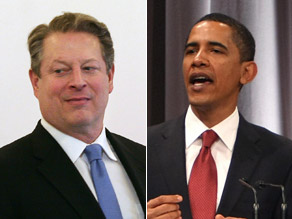
Obama Wants Gore on His Team

Found on CNN's PoliticalTicker Blog...


(CNN) — Al Gore has a spot in a potential Barack Obama administration, the Illinois senator said Wednesday.

Asked at a campaign event if he'd consider Gore for his cabinet, Obama immediately said he would.

" I will make a commitment that Al Gore will be at the table and play a central part in us figuring out how we solve this [climate change] problem," Obama said.

Obama also said he talks with the former vice president on a "regular basis," and often consults with him on climate change issues.

Could Gore serve alongside Bill Clinton in an Obama administration? Last November, the Illinois senator said he'd offer the former president a job "in a second."

"There are few more talented people [than Clinton]," Obama said then.

CNN's Alex Mooney and Chris Welch
April 2, 2008

Posted: 08:30 PM ET


Powered by ScribeFire.

Tuesday, April 01, 2008

Justice Interrogation Memo: Constitution Not In Play

Once again, I honor leaders like Senators Patrick Leahy and Chuck Hagel. While not perfect, they have been bold enough to speak truth to power...especially when that power aggressively and willingly abuses power, inflates fear, and acts with neither honor nor integrity.


Found on The Swamp, the Chicago Tribune's Washington Bureau Blog

Posted April 1, 2008 8:30 PM

by James Oliphant

The Justice Department late Tuesday released a declassified 2003 memorandum long sought by congressional Democrats and other administration critics that outlines the government's legal justification for harsh interrogation techniques used by the military against captured enemy combatants outside the United States.

The memo, written by John Yoo, then a key architect of legal policy in the wake of 9/11, dismisses several legal impediments to the use of extreme techniques.

Yoo was long a proponent of an aggressive approach in the war against terrorism and a believer in executive branch authority. But the memo was withdrawn as formal government policy less than a year after it was written.

In the March 14, 2003 memo, Yoo says the Constitution was not in play with regard to the interrogations because the Fifth Amendment (which provides for due process of law) and the Eighth Amendment (which prevents the government from employing cruel and usual punishment) does "not extend to alien enemy combatants held abroad.":

The memo goes on to explain that federal criminal statutes regarding assault and other crimes against the body don't apply to authorized military interrogations overseas and that statutes that do apply to the conduct of U.S. officials abroad pertaining to war crimes and torture establish a limited obligation on the part of interrogators to refrain from bodily harm.

It also defines the United States' obligations under the United Nations Convention Against Torture and other international treaties prohibiting torture to be confined to ensuring that interrogators do not apply "cruel and unusual punishment" as defined by American constitutional law, regardless of differing international standards.

And it restates the oft-repeated view held by administration officals that the Geneva Conventions, which governs the treatment of prisoners of war, does not apply to members of al Qaeda and the Taliban.

The memo also reflected Yoo's belief in that the executive branch had the inherent authority during wartime to obtain information by necessarily hazardous means:

"If a government defendant were to harm an enemy combatant during an interrogation in a manner that might arguably violate a criminal prohibition, he would be doing so in order to prevent further attacks on the United States by the al Qaeda terrorist network," Yoo wrote. "In that case, we believe that he could argue that the executive branch's constitutional authority to protect the nation from attack justified his actions."

It was during 2003, while the memo was operative, that guards and other military personnel committed the abuses of prisoners at Abu Ghraib in Baghdad, Iraq. The memo was withdrawn shortly thereafter, but before those abuses came to light.

The memo was prepared by Yoo for William Haynes, then the Pentagon's general counsel and another key player in the administration's legal strategy. It was declassified Monday by Haynes' acting successor, Daniel Dell' Orto. Yoo is now a law professor at the University of California at Berkeley.

Sen. Patrick Leahy (D-Vt.), chairman of the Senate Judiciary Committee, which has repeatedly asked the Justice Department to release the memo and others like it, had this to say Tuesday evening:

It has been more than four months since I asked the White House – again – to declassify the secret Justice Department opinions on interrogation practices. Today’s declassification of one such memo is a small step forward, but in no way fulfills those requests. The administration continues to shield several memos even from members of Congress.

The memo they have declassified today reflects the expansive view of executive power that has been the hallmark of this administration. It is no wonder that this memo, like the now-infamous “Bybee memo”, could not withstand scrutiny and had to be withdrawn. Like the “Bybee memo”, this memo seeks to find ways to avoid legal restrictions and accountability on torture and threatens our country’s status as a beacon of human rights around the world.

© 2008 Tribune Interactive


Powered by ScribeFire.

A-Rod is paid more than entire Marlins team

Is the ability of one player really worth that much? I guess pure sport went away a long-time ago...or perhaps it never really existed?


NEW YORK - Alex Rodriguez makes more this year than his hometown Florida Marlins.

Boosted by his new deal with the New York Yankees, A-Rod tops the major league baseball salary list at $28 million, according to a study of contract terms by The Associated Press. The 33 players on the Marlins’ opening-day roster and disabled list total $21.8 million.

“The Marlins? It’s amazing,” Rodriguez said. “And they still seem to find a way to be very competitive. They have a great pool of talent; they made some unbelievable trades, so they have great personnel people. To win two championships in 11 years, that’s really admirable, and I’m very proud of that organization, being from Miami.”

For the first time in baseball history, the average salary topped the $3 million mark. The 855 players on opening-day rosters and the DL averaged $3.15 million, up 7.1 percent from last year’s starting average of $2.94 million.

Florida’s highest earner doesn’t even make the average. Pitcher Kevin Gregg tops the Marlins at $2.5 million.

“My best friend came into town, and he mentioned something about Johan Santana making $15 million more than our five starters combined,” Marlins catcher Matt Treanor said. “It’s something to laugh at, but at the same time, it is what it is. Those guys put on the uniform like us. When it comes time to start the game, it doesn’t matter how much money the Yankees or whoever make.”

Treanor’s friend was exaggerating a bit — Santana makes $12 million more than Florida’s rotation. Still, the Marlins’ payroll was less than half that of the No. 29 team, Tampa Bay ($43.8 million).

“They’ve won a championship more recently than we have as an organization. So there’s many different ways to skin a cat,” said Yankees general manager Brian Cashman, whose team lost to Florida in the 2003 World Series. “Alex earned that contract in the negotiation. Right now, the Marlins are in a different place. But they’ve got a stadium coming on board and they’re going in the right direction, and I think they’ve already proven they know how to build something.”

The Yankees, not surprisingly, topped the payroll list at $209.1 million, and A-Rod was No. 1 in the majors for the eighth straight year. New York first baseman Jason Giambi was second at $23.4 million, followed by Yankees shortstop Derek Jeter ($21.6 million) and Boston left fielder Manny Ramirez ($18.9 million).

Boosted by the acquisition of Miguel Cabrera and Dontrelle Willis, Detroit shot up to second in the major leagues at $138.7 million. The Tigers’ payroll at the end of last season was 12th at $98.5 million.

“This isn’t one of those teams, ’I can’t believe we didn’t pick up this player, or this guy.’ We’ve got no excuses,” Tigers manager Jim Leyland said. “It’s all about us, because the main man has done everything and more that you could ask.”

The New York Mets were third at $138.3 million, up from $121 million at the end of 2007, and the World Series champion Boston Red Sox were fourth at $133.4 million.

Bunched together after that were the Chicago White Sox ($121.2 million), Los Angeles Angels ($119.2 million), Chicago Cubs ($118.6 million), Los Angeles Dodgers ($118.5 million) and Seattle Mariners ($118 million).

Although the average increased, the median salary — the point at which an equal amount of players fall above and below — remained at a record $1 million for the third straight opening day.

There were a record 434 making $1 million or more, breaking the record set in 2001 and matched last year. And there was a big boost at the top with 85 players reaching $10 million — up from 66 last year.

Payroll figures don’t include cash transactions between clubs. Figures included salaries and prorated shares of signing bonuses and other guaranteed income, and for some players, deferred money was discounted to present-day value.

The average salary usually declines during the season as veterans get released and are replaced by young players. The final 2007 average, as calculated by the players’ association, was $2.82 million.


updated 2:49 p.m. CT, Tues., April. 1, 2008

© 2008 The Associated Press. All rights reserved.

URL: http://nbcsports.msnbc.com/id/23904382/

© 2008 NBCSports.com

Army Allows Married Couples to Live Together in Iraq

If the bivouac is rockin', don't come a knockin'!


* Story Highlights
* Army allows married couples to live together in Iraq
* Public displays of affection still prohibited on duty, in mess hall
* Analysts: First war where army considered this step
* Sergeant: Talking with wife reduces stress

BAGHDAD, Iraq (AP) -- When American soldiers get off duty in Iraq, the men usually return to their quarters, the women to theirs. But Staff Sgt. Marvin Frazier gets to go back to a small trailer with two pushed-together single beds that he shares with his wife.

In a historic but little-noticed change in policy, the Army is allowing scores of husband-and-wife soldiers to live and sleep together in the war zone -- a move aimed at preserving marriages, boosting morale and perhaps bolstering re-enlistment rates at a time when the military is struggling to fill its ranks five years into the fighting.

"It makes a lot of things easier," said Frazier, 33, a helicopter maintenance supervisor in the 3rd Infantry Division. "It really adds a lot of stress, being separated. Now you can sit face-to-face and try to work out things and comfort each other."

Long-standing Army rules barred soldiers of the opposite sex from sharing sleeping quarters in war zones. Even married troops lived only in all-male or all-female quarters and had no private living space.

But in May 2006, Army commanders in Iraq, with little fanfare, decided that it is in the military's interest to promote wedded bliss. In other words: What God has joined together, let no manual put asunder.

"It's better for the soldiers, which means overall it's better for the Army," said Command Maj. Mark Thornton of the 3rd Infantry.

Military analysts said this is the first war in which the Army even gave the idea any serious consideration -- a reflection not only of the large number of couples sent to war this time, but also of the way the fighting has dragged on and strained marriages with repeated 12- and 15-month tours of duty.

While some couples were also sent into the 1991 Gulf War, the fighting was over before their living arrangements became an issue, said Lory Manning, a retired Navy captain who studies how military policies affect women for the nonprofit Women's Research and Education Institute.

More than 10,000 couples are in the Army. Exactly how many are serving in the war zone, and how many of those are living together, are not clear. The Army said it does not keep track.

But Frazier and his wife, Staff Sgt. Keisha Frazier, are among about 40 married Army couples living together on "Couples Row" at Camp Striker, which is on the outskirts of Baghdad and is one of more than 150 U.S. military camps in Iraq. Similarly, a Couples Row opened in October at nearby Camp Victory, though it has trailers for only seven of the many couples who have requested them.

Husbands and wives are still prohibited from public displays of affection, under the same strict regulations that govern unmarried men and women in uniform. Holding hands and kissing, whether on duty or in the chow hall, are against the rules.

"It's rough on marriages when, over the course of years, you don't see each other," Manning said. "It would make sense, certainly from a morale perspective and for the Army, to try to preserve marriages."

The only downside of married soldiers sharing sleeping quarters, she said, would be an increased risk of pregnancies.

John Pike, director of the military think tank Globalsecurity.org., said: "I think they are looking under the sofa cushions for anything they can do to improve retention. They spend a lot of money getting these people trained up."

After spending the first five months of their 15-month deployment on separate bases in tents with up to 15 other soldiers, all of the same sex, the Fraziers prize the small degree of privacy and intimacy they gained after moving in together in October.

Still newlyweds, Sgt. Amanda Christoper, 25, and her husband, Sgt. Matthew Christopher, 22, said the change in rules has been a blessing for their nearly year-old marriage, four months of which has been spent in Iraq.

Both work at the military hospital in Baghdad's fortified Green Zone, where Amanda is a licensed practical nurse and Matthew is in patient administration, which can include mortuary duties.

"Some of the stuff I've seen, if she weren't here, I'd be a lot less cool about it," Matthew said as the pair sat inside their potpourri-scented living quarters -- a mere 120 square feet, with a TV set atop two black lockboxes, an impressive collection of stuffed animals and a Chicago Bears plaque. "There was one night in particular, I saw something and I just thought, 'Oh, God.' I came in here, talked to her for a few minutes, went outside, took a deep breath and I was good to go."

Because of the prohibition on public displays of affection, the Christophers declined even to put their arms around each other for a photo.

"It's not like in the civilian world where if you see your boyfriend at work you can just go, 'Oh, hi, Babe,"' Amanda said. "We're in uniform, and we have to maintain a professional demeanor at work."

Capt. Jessica Hegenbart and her husband, Chief Warrant Officer Brian Hegenbart, had to live separately for two months when they arrived at Camp Striker because all the trailers for couples were full and were mostly allotted by rank. They finally moved in together in June.

"It's nice to come back to our trailer. I just feel bad for all those guys who don't have that to come home to every day," said Brian, a 32-year-old Black Hawk helicopter pilot.

Living together, however, doesn't stop the Hegenbarts from worrying about each other's safety. Sometimes, it can make it harder.

"Because we're so close out here, we know to the hour when our loved one's supposed to be home from a mission," Jessica said. "So if they're late, our brains starts going to that place where you start to wonder what went wrong. That happens more often than I'd like to admit."

Copyright 2008 The Associated Press. All rights reserved.

Find this article at:
http://www.cnn.com/2008/LIVING/wayoflife/04/01/combat.marriages.ap/index.html

© 2008 Cable News Network
Super Pii Pii Brothers In Action

Super Pii Pii Brothers: Amazing Virtual Pee Experience from Japan

A friend of mine just shared this with me. My first thought was...see ladies it is not as easy as it looks! See post above for a demonstration of the game in action...

As any good geek should know by now Japan has some of the wackiest and most unusual products anywhere. So when we were visiting Tokyo recently and saw lines of Japanese schoolgirls waiting to play an amazing new game for the Wii called Super Pii Pii Brothers we were only a little surprised. After all with games like WarioWare and Raving Rabbids the Wii is no stranger to crazy gameplay mechanics... but it was quite unusual to see the "strap-on" style accessory and peeing action that Pii Pii Brothers provides. Normally ThinkGeek doesn't carry video games, but we were so blown-away by Super Pii Pii Brothers that we immediately got our trusted Japanese importer on the phone and arranged to bring over a limited quantity of this amazing Wii game along with some cross regional boot discs to allow play on USA Wii consoles.

The play mechanics are simple. Prepare yourself by strapping on the included belt harness and jacking in your Wiimote. A series of toilets are presented on screen and the challenge is to tilt your body to control a never-ending stream of pee. Get as much pee in the toilets as you can while spilling as little on the floor as possible. Sounds easy eh? Well the toilets open and close whack-a-mole style and occasionally the stray cat or other cute critter pops up. Spray a cat for extra points. Get too much pee on the ground and your game is over. With realistic fluid dynamics for the pee and over 100 different bathrooms from bars and palaces to automatic Japanese style toilets you'll be entertained for hours. And wait until your friends see the multi-player mode with dueling pee streams...

According to the Japanese text on the box "Super Pii Pii Brothers promotes good bathroom skills and allows women to experience for the first time the pleasure of urinating while standing." What we say is that virtual peeing is damn fun!

Product Features:

* Video Game for Nintendo Wii Provides a Virtual Peeing Experience
* Amazing Realistic Pee Fluid Dynamics
* Imported from Japan
* Comes with game disc and Wiimote belt harness
* Includes cross regional boot disc to allow play on US Wii consoles
* Minimal Japanese text makes game easy to understand if you can't read Japanese
* Over 100 different peeing environments with multiple toilet and urinal styles
* Up to two players can compete with dueling pee streams

© Copyright 1999-2008 - ThinkGeek, Inc. All Rights Reserved

Thursday, March 27, 2008

Obama Attacks Wall Street While Taking Their Money

I am trying to be an equal opportunity offender, so here is a reasonable challenge to Senator Barack Obama that I found on the NPR News Blog. Speak truth to power...


Senator Obama's speech today outlined his differences with the other presidential candidates regarding the crisis on Wall Street. But it also highlighted the degree to which all three major candidates are involved with Wall Street.

In assigning blame for the subprime mortgage collapse, as well as for other financial woes, Obama went further than either his Democratic rival, Hillary Clinton, or Republican John McCain.

He spread the blame around... but largely in Washington. He said both Democrats and Republicans, quote, let the special interests put their thumbs on the economic scales.

"The future cannot be shaped by the best-connected lobbyists with the best record of raising money for campaigns. This thinking is wrong for the financial sector and it's wrong for our country."

"Obama is now the number one recipient of securities and investment money among the presidential candidates," says Sheila Krumholz, director of the Center for Responsive Politics. She says the center's analysis of campaign finance data shows that Obama has raised 6.7 million dollars from people and political action committees in the securities and investment industry.

Hillary Clinton is right behind him, at 6 point 6 million. McCain trails the Democrats, at about 3 million.

This just might explain why none of them -- most notably Obama or Clinton -- has been beating the drum for punishing investment firms, or their executives, for their roles in this financial mess.

Bashing Wall Street was once a fine tradition in the Democratic party. At the 1936 nominating convention, President Franklin Roosevelt lit into business and financial monopoly, speculation, reckless banking, and a few others.

"They are unanimous in their hate for me. And I welcome their hatred," said Roosevelt.

The kind of thing a Democrat would say 72 years ago, but not today.

Earlier this week, Clinton offered her solutions for the housing crisis. She urged that Washington should help homeowners just as much as it helps Wall Street. "We've seen unprecedented action to maintain confidence in our credit markets and head off a crisis for Wall Street banks. It's now time for equally aggressive action to help families avoid foreclosure."

On Tuesday, Republican McCain weighed in. He said that no assistance should be given to speculators. But he was talking about home buyers, not the folks who sold them the mortgages. For the industry, McCain said, government aid should be based only on heading off major systemic risks in the future.

At the Center for Responsive Politics, Krumholz says that in recent history, Wall Street has been careful to go with the winner -- Congressional Republicans in the late 1990s. President Bush in 2000 and 2004. And now she says, "The securities and investment industry, & specifically the more aggressive players, the hedge funds & the private equity funds, are leaning more to the left than they have in the past, & the hedge funds and private equity, the more aggressive players, are leaning more to the left than the industry as a whole."

And Democrats are happy to be leaned on.

Just after his speech this morning, Obama's schedule included a fundraising lunch at the Manhattan offices of Credit Suisse, the multi-national investment bank. Seats were priced from 1 thousand dollars to 23 hundred dollars. The lunch has long been sold out.

-- Peter Overby

5:25 PM ET | 03-27-2008 | permalink

Powered by ScribeFire.

Pentagon: Inventory Ordered of All U.S. Nukes

OMG!!!!! We are not absolutely sure where all of our nukes are?! Humm...and we are worried that Iran or North Korea would give nukes to terrorists! What if we accidentally already shipped them to the terrorists?! Kudos to Secretary Gates for at least ordering an immediate and thorough inventory.


* Defense Secretary Robert Gates orders accounting of all weapons
* U.S. mistakenly shipped four nuclear warhead fuses to Taiwan in 2006
* Gates' order: All nukes and nuke materials to be counted by serial number
* An inquiry is expected regarding the Taiwan shipment, Pentagon says

WASHINGTON (CNN)
-- Defense Secretary Robert Gates has formally ordered the Air Force, Navy and Defense Logistics Agency to conduct an inventory of all U.S. nuclear weapons and nuclear weapon-related materials to make sure all items are accounted for, according to a Pentagon memo released Thursday.

The order comes in the wake of the discovery last week that four nuclear warhead fuses were accidentally shipped to Taiwan in 2006.

Gates' memo, issued Wednesday, calls for all items to be accounted for by serial number.

Pentagon officials said at a news conference Tuesday that Gates would call for the review in addition to a full investigation into how the shipment to Taiwan from a Defense Logistics Agency warehouse happened 18 months ago.

The inventory review, which will involve thousands of items, is due to Gates in 60 days. Pentagon officials said the request was ordered, in part, because this latest incident comes after the August 2007 accidental flight of six nuclear-tipped cruise missiles on a B-52 bomber across the country.

"At a minimum, your report should include the results of the inventory and your personal assessment of the adequacy of your respective department or agency's positive inventory control policies and procedures," Gates said in the memo.

Four officers --- including three colonels -- were relieved of duty last year after a B-52 bomber mistakenly carried six nuclear warheads from North Dakota to Louisiana, the Air Force said.

A six-week investigation uncovered a "lackadaisical" attention to detail in day-to-day operations at the bases involved in the incident, an Air Force report said.

From Barbara Starr

Find this article at: http://www.cnn.com/2008/US/03/27/pentagon.nuclear.review/index.html

© 2008 Cable News Network


Powered by ScribeFire.

Tuesday, March 25, 2008

Huge Antarctic Ice Chunk Collapses

There is no such thing as global climate change due to human accelerated atmospheric carbon output. People like this need to be silenced...they are dangerous to political stability and economic expansion. I believe that President Bush must take action by declaring such voices as anti-American and supporting terrorists; and protect us from them by placing them secretive prisons around the globe via extraordinary rendition. The President should strip them of their rights and remove them from the oversight of the liberal judges. We cannot be trusted to do the right thing...we must trust our leader to do it for us!


* Antarctic ice chunk seven times the size of Manhattan collapses
* Rest of ice shelf is hanging by a narrow beam of thin ice
* Larger, more dramatic ice collapses occurred in 2002 and 1995

WASHINGTON (AP) -- A chunk of Antarctic ice about seven times the size of Manhattan suddenly collapsed, putting an even greater portion of glacial ice at risk, scientists said Tuesday.

Satellite images show the runaway disintegration of a 160-square-mile chunk in western Antarctica, which started February 28. It was the edge of the Wilkins ice shelf and has been there for hundreds, maybe 1,500 years.

This is the result of global warming, said British Antarctic Survey scientist David Vaughan.

Because scientists noticed satellite images within hours, they diverted satellite cameras and even flew an airplane over the ongoing collapse for rare pictures and video.

"It's an event we don't get to see very often," said Ted Scambos, lead scientist at the National Snow and Ice Data Center in Boulder, Colorado. "The cracks fill with water and slice off and topple... That gets to be a runaway situation."

While icebergs naturally break away from the mainland, collapses like this are unusual but are happening more frequently in recent decades, Vaughan said. The collapse is similar to what happens to hardened glass when it is smashed with a hammer, he said.

The rest of the Wilkins ice shelf, which is about the size of Connecticut, is holding on by a narrow beam of thin ice. Scientists worry that it too may collapse. Larger, more dramatic ice collapses occurred in 2002 and 1995.

Vaughan had predicted the Wilkins shelf would collapse about 15 years from now.

Scientists said they are not concerned about a rise in sea level from the latest event in Antarctica, but say it's a sign of worsening global warming.

Such occurrences are "more indicative of a tipping point or trigger in the climate system," said Sarah Das, a scientist at the Woods Hole Oceanographic Institute.

Copyright 2008 The Associated Press. All rights reserved.

Monday, March 24, 2008

Did You Celebrate Dyngus Day Today?

I am so glad that I did not grow up in a Polish culture! I would have been beaten to a pulp as a young man if I attempted to throw water on the girls that I liked then attempted to hit them in the legs with willow or birch branches. Wow, what a holiday?! By the way, my wife, the former Missy Janczewski, comes from a Polish and Russian family, but has never heard of Dyngus Day. Alas, the Borgification of culture in Lucedale, Mississippi.


(A picture taken of boys filling buckets and water pistols with water drawn from a town water pump on Easter Monday in Skwierzyna, Lubuskie, Poland. In Poland this day is known as Śmingus Dyngus and is a tradition, which involves boys running around the villages, towns and cities of Poland throwing water on others. Tradition states that girls who get caught and soaked with water will marry within the year.)

Dyngus Day (Smigus Dyngus)

by Melissa Block

Listen Now: Windows Media

All Things Considered, April 21, 2003 · NPR's Melissa Block talks with Mark Kohan, editor in chief of the Polish-American Journal, about the Polish holiday of Smigus Dyngus -- better known as Dyngus Day or Wet Monday. On this day in Polish tradition, boys soak girls with water on the day after Easter. The tradition lives on among Polish-Americans, especially in Buffalo, N.Y., where dozens of parties, complete with polka music and squirt guns, are scheduled today.

Sunday, March 23, 2008

Grim Milestone: 4,000 U.S. service employees dead in Iraq war

Gee, how wonderful to hear...at least one Iraqi understands how our mothers, widows, and children feel about loosing the ones they love in this war. That makes it all worth it to me! Let's send some more of our kids to kill others' kids...as long as someone understands how we must feel.


* NEW: As Iraq war enters sixth year, American death toll rises to 4,000
* At least 30 Iraqis died Sunday; 80,000 to 150,000 or more killed since war's start
* Iraq security adviser said Sunday that Iraq war is "well worth fighting"
* Democratic senator: Pause in withdrawal sends "wrong message to the Iraqis"

BAGHDAD, Iraq (CNN) -- Four U.S. soldiers died in a roadside bombing in Iraq on Sunday, military officials reported, bringing the American toll in the 5-year-old war to the grim milestone of 4,000 deaths. Eight of the 4,000 killed were civilian employees of the Pentagon.

The four were killed when their vehicle was hit by an improvised explosive device while patrolling a neighborhood in southern Baghdad, the U.S. military headquarters in Iraq reported Sunday night. A fifth soldier was wounded in the attack, which took place about 10 a.m. (3 a.m. ET).

The news came on the same day that Iraq's national security adviser urged Americans to be patient with the progress of the war, contending that it is "well worth fighting" because it has implications about "global terror."

"This is global terrorism hitting everywhere, and they have chosen Iraq to be a battlefield. And we have to take them on," Mowaffak al-Rubaie said Sunday on CNN's "Late Edition with Wolf Blitzer."

"If we don't prevail, if we don't succeed in this war, then we are doomed forever," he said. "I understand and sympathize with the mothers, with the widows, with the children who have lost their beloved ones in this country.

"But honestly, it is well worth fighting and well worth investing the money and the treasure and the sweat and the tears in Iraq."

The war has just entered its sixth year. It started March 19, 2003.

Estimates of the Iraqi death toll range from about 80,000 to 150,000 or more. At least 30 Iraqis were killed Sunday, officials said.

Nearly 160,000 U.S. troops remain in Iraq, and the war has cost U.S. taxpayers about $600 billion, according to the House Budget Committee.

The conflict is now widely unpopular among Americans: A CNN-Opinion Research Corp. poll out Wednesday found only 32 percent of Americans support the conflict. And 61 percent said they want the next president to remove most U.S. troops within a few months of taking office.

In the weekly Democratic radio address Saturday, Sen. Bob Menendez of New Jersey said President Bush "took us to war on the wings of a lie."

Menendez said that the war has depleted the resources and morale of the U.S. military; diverted national attention away from the war in Afghanistan, where al Qaeda is regrouping; and hurt the hunt for Osama bin Laden. The Iraq war has not made Americans safer, Menendez said, but has instead hurt the U.S. economy.

The senator called for a "responsible new direction" regarding Iraq.


CNN learned last week, from several U.S. military officials familiar with the recommendations but not authorized to speak on the record, that senior U.S. military officials are preparing to recommend to Bush a four- to six-week "pause" in additional troop withdrawals from Iraq after the last of the "surge" brigades leaves in July.

"If the conditions on the ground dictate that we have to have a pause, then we will have to have a pause," al-Rubaie said.

The return of all five brigades added to the Iraq contingent last year could reduce troop levels by up to 30,000, but still leave approximately 130,000 or more troops in Iraq.

Al-Rubaie emphasized Sunday that any drawdown of U.S. troops "has to be based on the conditions on the ground."

"It depends on the development and the growth and the equipment and the capabilities of the Iraqi security forces, and the preparedness of the Iraqi security forces," he said. "This should not be a purely political decision. It should be also a technical, military and intelligence decision."

But there has been too much "foot-dragging on key governance questions in Iraq," Democratic Sen. Ron Wyden of Oregon said on CNN on Sunday. "It seems to me you put off those troop withdrawals, you send exactly the wrong message to the Iraqis."


On Wednesday, Bush will visit the Pentagon to be briefed by the Joint Chiefs of Staff, chaired by Adm. Michael Mullen.

The American troop level in Iraq "depends on the negotiations that we are engaged in now between the government of Iraq and the United States government," al-Rubaie said.

When conditions warrant the withdrawal of American troops, the Iraqis will say "'Thank you very much, indeed,' " al-Rubaie said. "A big, big thank you for the United States of America for liberating Iraq, for helping us in sustaining the security gains in Iraq ... and we will give them a very, very good farewell party then."

Responding to recent remarks from U.S. presidential candidates that Iraqis are not taking responsibility for their own future, al-Rubaie said Iraqis are making political and security gains.

"Literally by the day and by the week, we are gradually assuming more responsibility," he said, noting that Iraqis have taken responsibility for security in many provinces.

Other developments:

• U.S. troops raided a suspected suicide bomber cell in Diyala province on Sunday, killing a dozen militants, half of whom had shaved their bodies -- which the U.S. military says indicates they were in the final stage of preparation for a suicide attack. Diyala province stretches north and east of Baghdad and has been a major front for U.S. troops fighting militants.

• Several mortars landed in Baghdad's International Zone on Sunday, according to the Interior Ministry. A U.S. Embassy spokeswoman said there were no major casualties.

• A suicide car bomb exploded at a fuel station Sunday in a predominantly Shiite neighborhood in northwest Baghdad, killing seven people and wounding 12 others, the Interior Ministry said.

• A suicide bomber detonated a truck full of explosives outside the main gate of an Iraqi military base in Mosul, killing at least 10 Iraqi soldiers and wounding 35 people, including 20 soldiers, Mosul police said. The U.S. military put the death toll higher, at 12.

• A mortar round landed in a Shiite neighborhood in eastern Baghdad, killing seven people and injuring nine others, a ministry official said. Six more mortar rounds landed in other Baghdad neighborhoods Sunday night, killing three people, the Interior Ministry said.

• In southeastern Baghdad, gunmen riding in at least two cars opened fire on a crowded outdoor market, killing at least three people and wounding 17 others, the Interior Ministry said.

• A suicide bomber detonated a small truck rigged with explosives outside a local Awakening Council leader's house just east of Samarra on Saturday, killing at least five people and wounding 13 others, a Samarra police official said. Awakening Councils are largely Sunni security groups that have been recruited by the U.S. military.


http://www.cnn.com/2008/WORLD/meast/03/23/iraq.main/index.html?eref=rss_topstories


© 2008 Cable News Network


Powered by ScribeFire.

Friday, March 21, 2008


Richardson Calls Out Clinton Adviser: Richardson’s backing was sought by both the Clinton and Obama campaigns.


(CNN) – Bill Richardson criticized a Clinton campaign adviser Friday for suggesting his endorsement of Barack Obama is insignificant.

"I resent the fact that the Clinton people are now saying that my endorsement is too late because I only can help with Texans — with Texas and Hispanics, implying that that's my only value," the New Mexico governor told CNN's John King.

"That's typical of some of his advisers that kind of turned me off."Earlier Friday, Clinton campaign senior strategist Mark Penn said he thought Richardson's endorsement came too late to make an impact.

“The time that he could have been effective has long since passed," Penn told reporters on a conference call. "I don’t think it is a significant endorsement in this environment.”

In the interview Friday, Richardson also said he called Hillary Clinton Thursday to inform her of his decision to back Obama, a conversation he described as "painful."

"It was painful and it wasn't easy," he said. "I've spoken to others who have had that same conversation and they say at the end, it’s not all that pleasant.

"The former Democratic presidential candidate declined to elaborate further on his conversation with Clinton.Last month, Chris Dodd — another former presidential candidate who decided to endorse Obama last month — said he had a "not comfortable" conversation with Clinton informing her of the news.

Also in the interview Friday, Richardson said he ultimately decided to back Obama because the Illinois senator has "something special."

"I think that Sen. Obama has something special,” explained Richardson. “Something that can bring internationally America’s prestige back, that can deal with the race issue as he did so eloquently last week, that can deal with the domestic issues in a bipartisan way."

Richardson, who held posts as the Secretary of Energy and the U.S. Ambassador to the U.N. in President Clinton’s administration, also said he "owes a lot to the Clinton family but I served well. I paid it back in service to the country."


Posted on CNN's politicalticker at 05:15 PM ET

Thursday, March 20, 2008

Is Hagel right that it may be time for a new political party?

FROM CNN’s Jack Cafferty:


The U.S. needs independent leadership and maybe even a new political party.

Senator Chuck Hagel, the Nebraska Republican and one of the very few class acts in Washington, has a new book out, “America: Our Next Chapter.” Hagel writes, “In the current impasse, an independent candidate for the presidency, or a bipartisan unity ticket… could be appealing to Americans.”

Hagel, who is a Vietnam veteran, also suggests that the war in Iraq might be remembered as one of the five biggest blunders in all of history. He says that the invasion 5 years ago was “the triumph of the so-called neoconservative ideology, as well as Bush administration arrogance and incompetence.”


Hagel says he held one of the Senate’s strongest records of support for President Bush, but his standing as a Republican was still doubted because of his opposition to the administration’s foreign policy – one he sees as “reckless” and “divorced from a strategic context.”


Hagel announced last year that he wouldn’t run for a third Senate term or seek the Republican nomination for president. His name was often mentioned as a potential running mate for New York Mayor Michael Bloomberg on an independent presidential ticket. But last month, Bloomberg said he wouldn’t run.

Posted: March 20, 2008 at 04:35 PM ET


Powered by ScribeFire.

A Stupid Conversation: As the United States and Europe bicker, the Atlantic alliance is losing influence

I wonder if what the world most needs from the United States is for the United States to abide by its Constitution (rather than work around it), set an example of Liberty at home (rather than impose it abroad), and speak truth to the world (rather than vomiting self-serving hack)?! The greatest influence we can have is on the imagination of others...

Reports of the death of American hegemony have been greatly exaggerated, as I argued in my last column. But this does not mean all is well. The fall of the dollar is one obvious indicator of relative decline; Iranian President Mahmoud Ahmadinejad's celebratory visit to Baghdad is another. Last week, French Foreign Minister Bernard Kouchner told the International Herald Tribune's Roger Cohen that "the magic is over."

America and Europe face political, economic and demographic challenges to their longstanding primacy. This is a delicate moment for a power transition, given the host of emerging global threats: global warming, nuclear proliferation, macroeconomic imbalances, terrorism, the need to reform global governance and so on. The question is, can the United States and the European Union continue to exercise leadership on these issues? The answer, at best, is, "not for long."

The signals of a decline in Western influence are getting hard to ignore. The Center for Transatlantic Relations reports a mixed bag. On the one hand, in 2006 the United States and European Union were responsible for less than 30 percent of world exports. On the other hand, the two regions accounted for more than 75 percent of outward foreign direct investment. As Polish Foreign Minister Radoslaw Sikorski recently put it, "talk of decline of the West is as old as the West itself."

To assess the strength of the transatlantic relationship, I attended the Brussels Forum, an all-star confab orchestrated by the German Marshall Fund (GMF). The conference made it clear that relations between America and Europe have recovered significantly from the trough of 2002-2003. This accords with public opinion. A just-released British Council poll found that strong majorities in America and Europe want a closer partnership. Both the United States and the European Union have been humbled in recent years by missteps in the application of hard power and soft power, as Constanze Stelzenmüller pointed out in a GMF briefing paper. The rise of new state threats (Russia, Iran) and nonstate threats (see above) have led the transatlantic neighborhood to recognize that they have more common than divergent interests.

That's the good news. The bad news is that it is far from clear whether Washington and Brussels are truly focused on external challenges and threats. The same poll revealed that both Americans and Europeans were unimpressed with transatlantic cooperation on peacekeeping, global warming, human rights, poverty reduction and counterterrorism. The elites attending the Brussels Forum seem to share this skepticism. When panelists at one meeting devoted the bulk of their time to carping about past disputes (like NATO expansion) and second-tier issues (like Kosovo), former U.S. ambassador to the United Nations Richard Holbrooke complained: "We're having a really stupid conversation."

Unfortunately, this trope repeated itself throughout the conference. At dinner one evening, I was sandwiched between a Bundestag representative and an Austrian ambassador. Conversation was lacking until the question of Turkish admission to the European Union came up. Both guests remarked that it was a mistake to have offered the Ankara accession negotiations to admit Turkey to the EU. They agreed that Russia was more a part of Europe than Turkey. At the same time, rumors were flying of a secret plan to sneak Turkey into the Union. This symbolizes a chronic problem that plagues the EU: any effort to present a common external front gets sidetracked by persistent questions about defining Europe's borders.

The United States is just as incapable of action. Lt. Gen. Karl Eikenberry said that for state-building to proceed in Afghanistan, military efforts need to be augmented with civilian efforts. NATO Secretary-General Jaap de Hoop Scheffer concurred, noting that there was "a substantial gap" between military and civilian capacities for crisis management. This echoed a theme that Secretary of Defense Robert Gates stressed late last year: the State Department needs more money and resources to advance American interests in the Middle East. When one cabinet secretary lobbies for more money for a different cabinet agency, it's a sign that America's foreign-policy budget is way out of whack.

On issues where the transatlantic partnership really does have the lead, it's hard to see forward progress. In Afghanistan, NATO is paralyzed by the fact that only the Canadians are willing to send troops to the Kandahar region. If the alliance cannot scrape together another battalion to send to the region before NATO's Bucharest summit next month, then the Canadians will withdraw.

On trade, no one at the conference sees any forward progress on the Doha Round; experts were advocating a "pause" in those talks. Trade liberalization is a negotiation process in which the parties ostensibly see a win-win. If the United States and European Union cannot agree on reducing agricultural subsidies, how can they possibly agree on how to reduce global warming?

Perhaps the West's difficulties are overstated. Perhaps conferences like the Brussels Forum allow Americans and Europeans to vent their frustrations as a first step toward problem solving. Nevertheless, both the Bush administration and the Barroso Commission are in their lame-duck years. At a time when urgent action is needed, status-quo policies are likely until 2009.

Perhaps the magic is still there, but as Kouchner gloomily concluded, "I knew what was the West, and I don't know what the West is now."

By Daniel Drezner


Updated: 6:15 PM ET Mar 20, 2008

URL: http://www.newsweek.com/id/124417

© 2008


Powered by ScribeFire.

Wednesday, March 19, 2008

Looking Backwards In Order To Move Forward: A New Chance To Fix The GDP Metric

I think there is something to this. While it may be as illusive as Einstein's Unified Field Theory, finding a way to truly measure the health of our society, not just an economic metric, could positively impact national, state, and local policy-making.

Today, March 18, 2008 is the fortieth anniversary of one of Robert F. Kennedy's most famous speeches, given just months before his assassination.

In it, RFK performed a rhetorical evisceration of our national economic report card, Gross National Product. You can watch a great new video of his remarks, prepared by the Glaser Progress Foundation. He said:

"Gross National Product counts air pollution and cigarette advertising, and ambulances to clear our highways of carnage. It counts special locks for our doors and the jails for the people who break them. It counts the destruction of the redwood and the loss of our natural wonder in chaotic sprawl. . . . Yet the gross national product does not allow for the health of our children, the quality of their education or the joy of their play. It does not include the beauty of our poetry or the strength of our marriages, the intelligence of our public debate or the integrity of our public officials. It measures neither our wit nor our courage, neither our wisdom nor our learning, neither our compassion nor our devotion to our country. It measures everything, in short, except that which makes life worthwhile. And it can tell us everything about America except why we are proud that we are Americans."

His words have circulated in the writings of economic critics ever since. Yet Washington, DC has done essentially nothing to correct the flawed accounts, until now. There’s now a chance for action.

Last week, US Senator Byron Dorgan held hearings on GDP accounting and declared his intention to improve it. (GNP has given way to GDP in public discourse, but there are no important differences between them.) His timing couldn’t be better. Outside of Washington, economists and statisticians have been quietly elaborating methods for giving the nation a better tally of its prosperity. A National Academy of Sciences panel, for example, has laid out an exhaustive, sober, and detailed plan for issuing regular reports on several “satellite accounts” in tandem with the monetary tally of GDP. The present administration stopped the Department of Commerce from adopting the improved methods.

A new president, supported perhaps by Senator Dorgan and like-minded leaders, will have the opportunity to seize the challenge RFK threw down four decades ago. The implications could be broader than you’d imagine. For example, whether we’re in a recession or not depends entirely on what our system of national accounts includes and excludes.

Imagine the news stories that might follow if satellite accounts were published along with GDP figures: "GDP up; parents' time with kids plummets." "GDP flat; education surges." "GDP and resource depletion both soar."

A decade of such headlines might refocus our national attention. It might spur us to organize our society to win on measures more meaningful than gross production: things like the health of our families, the strength of our communities, and the integrity of our natural heritage.

A few hours of hearings on Capitol Hill might not seem like much. But it was at least a small watershed. In his testimony at the hearing, Dr. Steven Landefeld, who runs the Department of Commerce bureau that tracks GDP, mentioned that in his thirteen years in that role he has never before been asked before a Congressional committee to discuss his agency’s work. Not once. Until last week.

Somewhere, Robert F. Kennedy is smiling.

(Disclosure: The Glaser Progress Foundation has long been a generous supporter of Sightline Institute, but I would have posted this even if I’d never heard of them.)


by Alan Durning
WorldChanging Team

March 19, 2008 11:07 AM


Powered by ScribeFire.

Clinton Calendars Full of Unexplained Private Meetings

I found this curious blog entry at Deep Background. I would hate to know that my life would be so thoroughly investigated and picked apart.

Former First Lady Hillary Rodham Clinton's calendar entries are full of unexplained private meetings on key dates when she and President Clinton were fending off a variety of scandals, the newly released White House records show.

Take Jan. 21, 1998. That's the day when most Americans first learned, courtesy of the Washington Post, that President Clinton had had a relationship with Monica Lewinsky. Mrs. Clinton's calendar entry shows that she left the White House at 7:25 pm that evening and returned 25 minutes later. The National Archives, which released the 17,484 calendar pages today, has excised the reason for the brief trip and the names of any of the people whom Mrs. Clinton may have met. The Archives, working in consultation with President Clinton's representatives, cite privacy concerns in blacking out all details of the trip.

Dec. 22, 2000 also remains a bit of a mystery. That's the day when Mrs. Clinton and the President met in the White House with a New York rabbi who successfully lobbied President Clinton to commute the sentences of four Hassidic men who had been convicted of massive fraud and conspiracy. The commutations were extremely controversial at the time, and photos of the meeting exist. And yet, there's no mention of it in Mrs. Clinton's daily log. The calendar simply lists four separate "private meetings" in the Map Room that day, with no names attached.

On Jan. 4, 1996, the calendars also record four "private" meetings that the First Lady held with her chief of staff, Maggie Williams, and undisclosed others. That's the same day that one of the First Lady's aides discovered a stack of Mrs. Clinton's law-firm billing records in the private quarters of the White House. Whitewater investigators had been searching for the subpoenaed documents for months.

A team of NBC News producers, correspondents and researchers pored over the White House logs today. The calendar entries show, as Sen. Clinton has argued on the campaign trail, that as first lady she had a continuing interest in substantive foreign policy matters, including Bosnia and the effort to find peace in Northern Ireland. “These documents are outlines of the First Lady's activities and illustrate the array of substantive issues she worked on,” Clinton campaign spokesman Jay Carson said. “Her daily schedules also list some of the meetings and travel she conducted to more than 80 countries in pursuit of the Administration's domestic and foreign policy goals.”

Foreign Policy Experience?
But the calendars also seem to show that, on occasion, Mrs. Clinton was not substantively involved with foreign affairs when a real 3 a.m. crisis hit the White House.

Take, for example, when Al Qaeda terrorists bombed the U.S. embassies in Kenya and Tanzania in 1998, killing hundreds of people. Mrs. Clinton’s schedule does not show any foreign policy meetings in the aftermath of the crisis, only a trip to Andrews Air Force Base to console victims and their families as they returned from Africa to the United States. And when, in retaliation for those embassy attacks, President Clinton bombed Al Qaeda terrorist camps in Afghanistan, where was Mrs. Clinton? The records show that she was vacationing at a “private residence” in Martha’s Vineyard, Ma., and had no official events.

Foreign trips offer a mixed review of Mrs. Clinton’s national-security experience. On a trip to Japan and Korea in 1993, for example, her schedule was filled with teas, tours of gardens and other traditional first lady fare. And on a trip to Russia in 1994, Mrs. Clinton met with other first ladies and attended coffees and tours, separate from her husband or the Russian president. Clinton campaign spokesman Carson described the calendars as only a “guide,” and said that they “of course cannot reflect all of Senator Clinton's activities as First Lady.”

Indeed, on overseas trips in 1996, Mrs. Clinton held "private" or "closed" meetings with foreign heads of state in Greece, Turkey, and Bosnia--without the president's attendance. And on dozens of times throughout her White House years, she attended White House meetings with Cabinet secretaries, was briefed by senior National Security Council officials and met with foreign dignitaries from around the world.

Posted on Wednesday, March 19, 2008 6:16 PM PT

By Jim Popkin, NBC News Senior Investigative Producer


--NBC News contributors to this report include: Erika Angulo, Rich Gardella, Alicia Jennings, EJ Johnson, Mike Kosnar, Luke Mayo, CarrollAnn Mears, Amna Nawaz, Aram Roston, Antoine Sanfuentes and Ken Strickland.


Powered by ScribeFire.

Tuesday, March 18, 2008

On Your Health: It seems our bodies are less like a temple...and more like a car!


Just like a car, your body needs routine maintenance. Here's an easy schedule to follow
Turn on and tune-up!
Woman on scale
Steve Cole / Getty Images

Just
like your car, your body needs routine maintenance. In the April issue
of Women’s Health, we put together an easy schedule to keep you on
track. This tune-up calendar will tell you what to do and when to do
it.

To live a long, healthy life, women should start
their body maintenance routine young. We recommend starting in your 20s
and continuing the schedule, with a few additions along the way, into
your 30s and 40s and beyond. No matter what your age, it’s never too
late to start taking proper care of yourself.

Daily

Floss
Even
if you brush twice a day, decay-causing bacteria can still lurk between
teeth. That sets you up for gum disease, which raises the risk of heart
disease, stroke, and, if you're pregnant, pre-term delivery. Gingivitis
can affect even young adults: More than 50 percent of people over 30
have it.

Step on the scale
Studies show that people who weigh themselves every day are more likely to maintain a healthy weight.

Take a multivitamin
Throughout
your 20s, a multivitamin offers an essential boost of iron and folic
acid. And no matter what your age, if you're trying to get pregnant (or
already are), you need these minerals to help prevent birth defects.

In your 30s and 40s, the calcium and vitamin D in a good multi will help keep your skeleton strong.

Get the 101 on vitamins here.

Weekly
Intimate couple
Lucas Lenci / Lucas Lenci Photo

Get it on
Research
has shown that having sex once or twice a week boosts by 30 percent
your body's production of immunoglobulin A, an antibody that sends
viruses and bacteria packing.
Every 3-6 months

Open up and say "ahh"
You
need to see your dentist at least twice a year to check for cavities,
get a professional polishing, and keep up with X-rays. Make sure at
least one visit each year includes an inspection of your lips, gums and
tongue for oral cancer: Because the disease spreads fast, early
detection is crucial.

Screen for STDs
Most are curable, but if you put off testing, you could compromise your fertility and your health.

Certain
you're not infected? Don't be: Noticeable symptoms often don't show up
for months, or ever. Get screened if you've recently had a new partner,
if the person you're seeing has (or you suspect it), or if you've never
been tested. The big three to check for are chlamydia, gonorrhea and
HIV. You can even order at-home tests through the mail.

Yearly
Eye chart and eyeglasses
Getty Images / MedioImages

Show your doc some skin
Melanoma
- the deadliest form of skin cancer - is on the rise in women, and 25
percent of those cases occur before age 40. See a dermatologist once a
year for a full-body screening.

And every couple of
months, do a mirror check for moles that are asymmetrical, have
irregular borders, change in color, or are larger than a pencil eraser.

See an ob-gyn
Show
up for the routine poking and prodding (i.e., a breast and pelvic exam
and a Pap smear) every year. If you're at high risk for cervical
cancer, ask your doctor for an HPV test too: Research shows that it's
nearly 40 percent better than the Pap at detecting precancerous lesions.

Have your eyes examined
Get
tested for glaucoma, macular degeneration, and cataracts starting at
age 35 - earlier if the guy across the bar starts looking less than
high-def.

Get a mammogram
Do it yearly starting at age
40. If you have a family history of breast cancer, get checked at least
five years before the earliest age that cancer was diagnosed in your
family. If you're at very high risk, your doc may also recommend an
MRI, which gives a more detailed picture of your breast tissue.

Every 2-3 years

Have a physical
Many
women figure that a yearly ob-gyn visit covers all the necessary bases.
But lots of health problems - including heart disease, the top killer
of women - can't be detected in your nether regions. In addition to any
tests you're due for, a doc should check your heartbeat, blood
pressure, height and weight.

Get a Pap smear
If
you're over 30 and have had two or more consecutive normal smears and
no new sexual partners, it's safe to reduce the frequency of your Paps.

Screen for diabetes
Get
your blood glucose levels checked once you hit 45. Go earlier if you're
overweight, have a family history of diabetes, or are trying to get
pregnant.

Every 5 years

Get a full lipid profile
Beginning
at age 20, have your LDL, HDL, total cholesterol and triglyceride
levels checked. If your levels are high, you may need to be screened
more frequently.

Get a thyroid check
More than
eight out of 10 thyroid disease patients are women, and since the
symptoms tend to be common complaints that are easy to dismiss (aches,
fatigue, weight gain), you may not even realize you have a problem.
Start having your thyroid hormone levels screened when you're 35.

Source: Women's Health

Updated: 5:00 p.m. ET Mar. 18, 2008

© 2008 MSNBC.com


URL: http://www.msnbc.msn.com/id/23692514/


Powered by ScribeFire.

Obama: "A More Perfect Union"

As Prepared for Delivery, on March 18, 2008

“We the people, in order to form a more perfect union.”

Two hundred and twenty one years ago, in a hall that still stands across the street, a group of men gathered and, with these simple words, launched America’s improbable experiment in democracy. Farmers and scholars; statesmen and patriots who had traveled across an ocean to escape tyranny and persecution finally made real their declaration of independence at a Philadelphia convention that lasted through the spring of 1787.

The document they produced was eventually signed but ultimately unfinished. It was stained by this nation’s original sin of slavery, a question that divided the colonies and brought the convention to a stalemate until the founders chose to allow the slave trade to continue for at least twenty more years, and to leave any final resolution to future generations.

Of course, the answer to the slavery question was already embedded within our Constitution – a Constitution that had at is very core the ideal of equal citizenship under the law; a Constitution that promised its people liberty, and justice, and a union that could be and should be perfected over time.

And yet words on a parchment would not be enough to deliver slaves from bondage, or provide men and women of every color and creed their full rights and obligations as citizens of the United States. What would be needed were Americans in successive generations who were willing to do their part – through protests and struggle, on the streets and in the courts, through a civil war and civil disobedience and always at great risk - to narrow that gap between the promise of our ideals and the reality of their time.

This was one of the tasks we set forth at the beginning of this campaign – to continue the long march of those who came before us, a march for a more just, more equal, more free, more caring and more prosperous America. I chose to run for the presidency at this moment in history because I believe deeply that we cannot solve the challenges of our time unless we solve them together – unless we perfect our union by understanding that we may have different stories, but we hold common hopes; that we may not look the same and we may not have come from the same place, but we all want to move in the same direction – towards a better future for of children and our grandchildren.

This belief comes from my unyielding faith in the decency and generosity of the American people. But it also comes from my own American story.

I am the son of a black man from Kenya and a white woman from Kansas. I was raised with the help of a white grandfather who survived a Depression to serve in Patton’s Army during World War II and a white grandmother who worked on a bomber assembly line at Fort Leavenworth while he was overseas. I’ve gone to some of the best schools in America and lived in one of the world’s poorest nations. I am married to a black American who carries within her the blood of slaves and slaveowners – an inheritance we pass on to our two precious daughters. I have brothers, sisters, nieces, nephews, uncles and cousins, of every race and every hue, scattered across three continents, and for as long as I live, I will never forget that in no other country on Earth is my story even possible.

It’s a story that hasn’t made me the most conventional candidate. But it is a story that has seared into my genetic makeup the idea that this nation is more than the sum of its parts – that out of many, we are truly one.

Throughout the first year of this campaign, against all predictions to the contrary, we saw how hungry the American people were for this message of unity. Despite the temptation to view my candidacy through a purely racial lens, we won commanding victories in states with some of the whitest populations in the country. In South Carolina, where the Confederate Flag still flies, we built a powerful coalition of African Americans and white Americans.

This is not to say that race has not been an issue in the campaign. At various stages in the campaign, some commentators have deemed me either “too black” or “not black enough.” We saw racial tensions bubble to the surface during the week before the South Carolina primary. The press has scoured every exit poll for the latest evidence of racial polarization, not just in terms of white and black, but black and brown as well.

And yet, it has only been in the last couple of weeks that the discussion of race in this campaign has taken a particularly divisive turn.

On one end of the spectrum, we’ve heard the implication that my candidacy is somehow an exercise in affirmative action; that it’s based solely on the desire of wide-eyed liberals to purchase racial reconciliation on the cheap. On the other end, we’ve heard my former pastor, Reverend Jeremiah Wright, use incendiary language to express views that have the potential not only to widen the racial divide, but views that denigrate both the greatness and the goodness of our nation; that rightly offend white and black alike.

I have already condemned, in unequivocal terms, the statements of Reverend Wright that have caused such controversy. For some, nagging questions remain. Did I know him to be an occasionally fierce critic of American domestic and foreign policy? Of course. Did I ever hear him make remarks that could be considered controversial while I sat in church? Yes. Did I strongly disagree with many of his political views? Absolutely – just as I’m sure many of you have heard remarks from your pastors, priests, or rabbis with which you strongly disagreed.

But the remarks that have caused this recent firestorm weren’t simply controversial. They weren’t simply a religious leader’s effort to speak out against perceived injustice. Instead, they expressed a profoundly distorted view of this country – a view that sees white racism as endemic, and that elevates what is wrong with America above all that we know is right with America; a view that sees the conflicts in the Middle East as rooted primarily in the actions of stalwart allies like Israel, instead of emanating from the perverse and hateful ideologies of radical Islam.

As such, Reverend Wright’s comments were not only wrong but divisive, divisive at a time when we need unity; racially charged at a time when we need to come together to solve a set of monumental problems – two wars, a terrorist threat, a falling economy, a chronic health care crisis and potentially devastating climate change; problems that are neither black or white or Latino or Asian, but rather problems that confront us all.

Given my background, my politics, and my professed values and ideals, there will no doubt be those for whom my statements of condemnation are not enough. Why associate myself with Reverend Wright in the first place, they may ask? Why not join another church? And I confess that if all that I knew of Reverend Wright were the snippets of those sermons that have run in an endless loop on the television and You Tube, or if Trinity United Church of Christ conformed to the caricatures being peddled by some commentators, there is no doubt that I would react in much the same way

But the truth is, that isn’t all that I know of the man. The man I met more than twenty years ago is a man who helped introduce me to my Christian faith, a man who spoke to me about our obligations to love one another; to care for the sick and lift up the poor. He is a man who served his country as a U.S. Marine; who has studied and lectured at some of the finest universities and seminaries in the country, and who for over thirty years led a church that serves the community by doing God’s work here on Earth – by housing the homeless, ministering to the needy, providing day care services and scholarships and prison ministries, and reaching out to those suffering from HIV/AIDS.

In my first book, Dreams From My Father, I described the experience of my first service at Trinity:

“People began to shout, to rise from their seats and clap and cry out, a forceful wind carrying the reverend’s voice up into the rafters….And in that single note – hope! – I heard something else; at the foot of that cross, inside the thousands of churches across the city, I imagined the stories of ordinary black people merging with the stories of David and Goliath, Moses and Pharaoh, the Christians in the lion’s den, Ezekiel’s field of dry bones. Those stories – of survival, and freedom, and hope – became our story, my story; the blood that had spilled was our blood, the tears our tears; until this black church, on this bright day, seemed once more a vessel carrying the story of a people into future generations and into a larger world. Our trials and triumphs became at once unique and universal, black and more than black; in chronicling our journey, the stories and songs gave us a means to reclaim memories tha t we didn’t need to feel shame about…memories that all people might study and cherish – and with which we could start to rebuild.”

That has been my experience at Trinity. Like other predominantly black churches across the country, Trinity embodies the black community in its entirety – the doctor and the welfare mom, the model student and the former gang-banger. Like other black churches, Trinity’s services are full of raucous laughter and sometimes bawdy humor. They are full of dancing, clapping, screaming and shouting that may seem jarring to the untrained ear. The church contains in full the kindness and cruelty, the fierce intelligence and the shocking ignorance, the struggles and successes, the love and yes, the bitterness and bias that make up the black experience in America.

And this helps explain, perhaps, my relationship with Reverend Wright. As imperfect as he may be, he has been like family to me. He strengthened my faith, officiated my wedding, and baptized my children. Not once in my conversations with him have I heard him talk about any ethnic group in derogatory terms, or treat whites with whom he interacted with anything but courtesy and respect. He contains within him the contradictions – the good and the bad – of the community that he has served diligently for so many years.

I can no more disown him than I can disown the black community. I can no more disown him than I can my white grandmother – a woman who helped raise me, a woman who sacrificed again and again for me, a woman who loves me as much as she loves anything in this world, but a woman who once confessed her fear of black men who passed by her on the street, and who on more than one occasion has uttered racial or ethnic stereotypes that made me cringe.

These people are a part of me. And they are a part of America, this country that I love.

Some will see this as an attempt to justify or excuse comments that are simply inexcusable. I can assure you it is not. I suppose the politically safe thing would be to move on from this episode and just hope that it fades into the woodwork. We can dismiss Reverend Wright as a crank or a demagogue, just as some have dismissed Geraldine Ferraro, in the aftermath of her recent statements, as harboring some deep-seated racial bias.

But race is an issue that I believe this nation cannot afford to ignore right now. We would be making the same mistake that Reverend Wright made in his offending sermons about America – to simplify and stereotype and amplify the negative to the point that it distorts reality.

The fact is that the comments that have been made and the issues that have surfaced over the last few weeks reflect the complexities of race in this country that we’ve never really worked through – a part of our union that we have yet to perfect. And if we walk away now, if we simply retreat into our respective corners, we will never be able to come together and solve challenges like health care, or education, or the need to find good jobs for every American.

Understanding this reality requires a reminder of how we arrived at this point. As William Faulkner once wrote, “The past isn’t dead and buried. In fact, it isn’t even past.” We do not need to recite here the history of racial injustice in this country. But we do need to remind ourselves that so many of the disparities that exist in the African-American community today can be directly traced to inequalities passed on from an earlier generation that suffered under the brutal legacy of slavery and Jim Crow.

Segregated schools were, and are, inferior schools; we still haven’t fixed them, fifty years after Brown v. Board of Education, and the inferior education they provided, then and now, helps explain the pervasive achievement gap between today’s black and white students.

Legalized discrimination - where blacks were prevented, often through violence, from owning property, or loans were not granted to African-American business owners, or black homeowners could not access FHA mortgages, or blacks were excluded from unions, or the police force, or fire departments – meant that black families could not amass any meaningful wealth to bequeath to future generations. That history helps explain the wealth and income gap between black and white, and the concentrated pockets of poverty that persists in so many of today’s urban and rural communities.

A lack of economic opportunity among black men, and the shame and frustration that came from not being able to provide for one’s family, contributed to the erosion of black families – a problem that welfare policies for many years may have worsened. And the lack of basic services in so many urban black neighborhoods – parks for kids to play in, police walking the beat, regular garbage pick-up and building code enforcement – all helped create a cycle of violence, blight and neglect that continue to haunt us.

This is the reality in which Reverend Wright and other African-Americans of his generation grew up. They came of age in the late fifties and early sixties, a time when segregation was still the law of the land and opportunity was systematically constricted. What’s remarkable is not how many failed in the face of discrimination, but rather how many men and women overcame the odds; how many were able to make a way out of no way for those like me who would come after them.

But for all those who scratched and clawed their way to get a piece of the American Dream, there were many who didn’t make it – those who were ultimately defeated, in one way or another, by discrimination. That legacy of defeat was passed on to future generations – those young men and increasingly young women who we see standing on street corners or languishing in our prisons, without hope or prospects for the future. Even for those blacks who did make it, questions of race, and racism, continue to define their worldview in fundamental ways. For the men and women of Reverend Wright’s generation, the memories of humiliation and doubt and fear have not gone away; nor has the anger and the bitterness of those years. That anger may not get expressed in public, in front of white co-workers or white friends. But it does find voice in the barbershop or around the kitchen table. At times, that anger is exploited by politicia ns, to gin up votes along racial lines, or to make up for a politician’s own failings.

And occasionally it finds voice in the church on Sunday morning, in the pulpit and in the pews. The fact that so many people are surprised to hear that anger in some of Reverend Wright’s sermons simply reminds us of the old truism that the most segregated hour in American life occurs on Sunday morning. That anger is not always productive; indeed, all too often it distracts attention from solving real problems; it keeps us from squarely facing our own complicity in our condition, and prevents the African-American community from forging the alliances it needs to bring about real change. But the anger is real; it is powerful; and to simply wish it away, to condemn it without understanding its roots, only serves to widen the chasm of misunderstanding that exists between the races.

In fact, a similar anger exists within segments of the white community. Most working- and middle-class white Americans don’t feel that they have been particularly privileged by their race. Their experience is the immigrant experience – as far as they’re concerned, no one’s handed them anything, they’ve built it from scratch. They’ve worked hard all their lives, many times only to see their jobs shipped overseas or their pension dumped after a lifetime of labor. They are anxious about their futures, and feel their dreams slipping away; in an era of stagnant wages and global competition, opportunity comes to be seen as a zero sum game, in which your dreams come at my expense. So when they are told to bus their children to a school across town; when they hear that an African American is getting an advantage in landing a good job or a spot in a good college because of an injustice that they themselves never committ ed; when they’re told that their fears about crime in urban neighborhoods are somehow prejudiced, resentment builds over time.

Like the anger within the black community, these resentments aren’t always expressed in polite company. But they have helped shape the political landscape for at least a generation. Anger over welfare and affirmative action helped forge the Reagan Coalition. Politicians routinely exploited fears of crime for their own electoral ends. Talk show hosts and conservative commentators built entire careers unmasking bogus claims of racism while dismissing legitimate discussions of racial injustice and inequality as mere political correctness or reverse racism.

Just as black anger often proved counterproductive, so have these white resentments distracted attention from the real culprits of the middle class squeeze – a corporate culture rife with inside dealing, questionable accounting practices, and short-term greed; a Washington dominated by lobbyists and special interests; economic policies that favor the few over the many. And yet, to wish away the resentments of white Americans, to label them as misguided or even racist, without recognizing they are grounded in legitimate concerns – this too widens the racial divide, and blocks the path to understanding.

This is where we are right now. It’s a racial stalemate we’ve been stuck in for years. Contrary to the claims of some of my critics, black and white, I have never been so naïve as to believe that we can get beyond our racial divisions in a single election cycle, or with a single candidacy – particularly a candidacy as imperfect as my own.

But I have asserted a firm conviction – a conviction rooted in my faith in God and my faith in the American people – that working together we can move beyond some of our old racial wounds, and that in fact we have no choice is we are to continue on the path of a more perfect union.

For the African-American community, that path means embracing the burdens of our past without becoming victims of our past. It means continuing to insist on a full measure of justice in every aspect of American life. But it also means binding our particular grievances – for better health care, and better schools, and better jobs - to the larger aspirations of all Americans -- the white woman struggling to break the glass ceiling, the white man whose been laid off, the immigrant trying to feed his family. And it means taking full responsibility for own lives – by demanding more from our fathers, and spending more time with our children, and reading to them, and teaching them that while they may face challenges and discrimination in their own lives, they must never succumb to despair or cynicism; they must always believe that they can write their own destiny.

Ironically, this quintessentially American – and yes, conservative – notion of self-help found frequent expression in Reverend Wright’s sermons. But what my former pastor too often failed to understand is that embarking on a program of self-help also requires a belief that society can change.

The profound mistake of Reverend Wright’s sermons is not that he spoke about racism in our society. It’s that he spoke as if our society was static; as if no progress has been made; as if this country – a country that has made it possible for one of his own members to run for the highest office in the land and build a coalition of white and black; Latino and Asian, rich and poor, young and old -- is still irrevocably bound to a tragic past. But what we know -- what we have seen – is that America can change. That is true genius of this nation. What we have already achieved gives us hope – the audacity to hope – for what we can and must achieve tomorrow.

In the white community, the path to a more perfect union means acknowledging that what ails the African-American community does not just exist in the minds of black people; that the legacy of discrimination - and current incidents of discrimination, while less overt than in the past - are real and must be addressed. Not just with words, but with deeds – by investing in our schools and our communities; by enforcing our civil rights laws and ensuring fairness in our criminal justice system; by providing this generation with ladders of opportunity that were unavailable for previous generations. It requires all Americans to realize that your dreams do not have to come at the expense of my dreams; that investing in the health, welfare, and education of black and brown and white children will ultimately help all of America prosper.

In the end, then, what is called for is nothing more, and nothing less, than what all the world’s great religions demand – that we do unto others as we would have them do unto us. Let us be our brother’s keeper, Scripture tells us. Let us be our sister’s keeper. Let us find that common stake we all have in one another, and let our politics reflect that spirit as well.

For we have a choice in this country. We can accept a politics that breeds division, and conflict, and cynicism. We can tackle race only as spectacle – as we did in the OJ trial – or in the wake of tragedy, as we did in the aftermath of Katrina - or as fodder for the nightly news. We can play Reverend Wright’s sermons on every channel, every day and talk about them from now until the election, and make the only question in this campaign whether or not the American people think that I somehow believe or sympathize with his most offensive words. We can pounce on some gaffe by a Hillary supporter as evidence that she’s playing the race card, or we can speculate on whether white men will all flock to John McCain in the general election regardless of his policies.

We can do that.

But if we do, I can tell you that in the next election, we’ll be talking about some other distraction. And then another one. And then another one. And nothing will change.

That is one option. Or, at this moment, in this election, we can come together and say, “Not this time.” This time we want to talk about the crumbling schools that are stealing the future of black children and white children and Asian children and Hispanic children and Native American children. This time we want to reject the cynicism that tells us that these kids can’t learn; that those kids who don’t look like us are somebody else’s problem. The children of America are not those kids, they are our kids, and we will not let them fall behind in a 21st century economy. Not this time.

This time we want to talk about how the lines in the Emergency Room are filled with whites and blacks and Hispanics who do not have health care; who don’t have the power on their own to overcome the special interests in Washington, but who can take them on if we do it together.

This time we want to talk about the shuttered mills that once provided a decent life for men and women of every race, and the homes for sale that once belonged to Americans from every religion, every region, every walk of life. This time we want to talk about the fact that the real problem is not that someone who doesn’t look like you might take your job; it’s that the corporation you work for will ship it overseas for nothing more than a profit.

This time we want to talk about the men and women of every color and creed who serve together, and fight together, and bleed together under the same proud flag. We want to talk about how to bring them home from a war that never should’ve been authorized and never should’ve been waged, and we want to talk about how we’ll show our patriotism by caring for them, and their families, and giving them the benefits they have earned.

I would not be running for President if I didn’t believe with all my heart that this is what the vast majority of Americans want for this country. This union may never be perfect, but generation after generation has shown that it can always be perfected. And today, whenever I find myself feeling doubtful or cynical about this possibility, what gives me the most hope is the next generation – the young people whose attitudes and beliefs and openness to change have already made history in this election.

There is one story in particularly that I’d like to leave you with today – a story I told when I had the great honor of speaking on Dr. King’s birthday at his home church, Ebenezer Baptist, in Atlanta.

There is a young, twenty-three year old white woman named Ashley Baia who organized for our campaign in Florence, South Carolina. She had been working to organize a mostly African-American community since the beginning of this campaign, and one day she was at a roundtable discussion where everyone went around telling their story and why they were there.

And Ashley said that when she was nine years old, her mother got cancer. And because she had to miss days of work, she was let go and lost her health care. They had to file for bankruptcy, and that’s when Ashley decided that she had to do something to help her mom.

She knew that food was one of their most expensive costs, and so Ashley convinced her mother that what she really liked and really wanted to eat more than anything else was mustard and relish sandwiches. Because that was the cheapest way to eat.

She did this for a year until her mom got better, and she told everyone at the roundtable that the reason she joined our campaign was so that she could help the millions of other children in the country who want and need to help their parents too.

Now Ashley might have made a different choice. Perhaps somebody told her along the way that the source of her mother’s problems were blacks who were on welfare and too lazy to work, or Hispanics who were coming into the country illegally. But she didn’t. She sought out allies in her fight against injustice.

Anyway, Ashley finishes her story and then goes around the room and asks everyone else why they’re supporting the campaign. They all have different stories and reasons. Many bring up a specific issue. And finally they come to this elderly black man who’s been sitting there quietly the entire time. And Ashley asks him why he’s there. And he does not bring up a specific issue. He does not say health care or the economy. He does not say education or the war. He does not say that he was there because of Barack Obama. He simply says to everyone in the room, “I am here because of Ashley.”

“I’m here because of Ashley.” By itself, that single moment of recognition between that young white girl and that old black man is not enough. It is not enough to give health care to the sick, or jobs to the jobless, or education to our children.

But it is where we start. It is where our union grows stronger. And as so many generations have come to realize over the course of the two-hundred and twenty one years since a band of patriots signed that document in Philadelphia, that is where the perfection begins.


Powered by ScribeFire.